

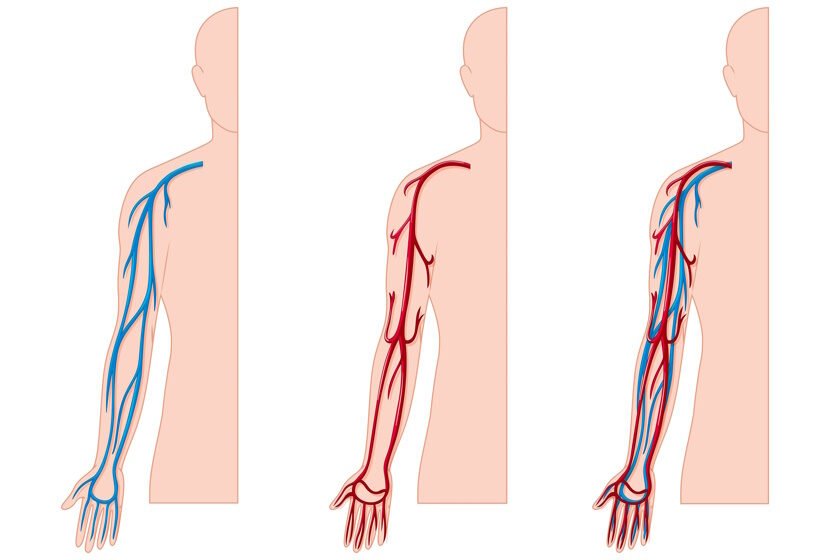
Arteries and veins perform different but equally important jobs in the circulatory system. Understanding the difference between an artery vs vein can make it easier to recognize common blood vessel problems and know when symptoms may require medical attention.
Arteries vs Veins: What Is the Difference?
Arteries generally carry oxygen-rich blood away from the heart to the body’s tissues, while veins return blood toward the heart. There are important exceptions, such as the pulmonary arteries and veins, which are involved in circulation between the heart and lungs.
The walls of arteries are thicker and more muscular because they handle blood under higher pressure. Veins have thinner walls and contain valves that help prevent blood from flowing backward, particularly in the legs.
| Feature | Arteries | Veins |
|---|---|---|
| Main direction | Away from the heart | Toward the heart |
| Typical blood | Usually oxygen-rich | Usually oxygen-poor |
| Pressure | Higher | Lower |
| Vessel walls | Thicker and more muscular | Thinner |
| Valves | Generally absent | Common, especially in leg veins |
| Common problems | PAD, aneurysms, carotid disease | DVT, varicose veins, venous insufficiency |
Common Artery Problems
Peripheral Artery Disease
Peripheral artery disease occurs when arteries supplying the legs or arms become narrowed or blocked. Atherosclerosis is one of the most common causes.
A person may develop pain or cramping in the legs while walking that improves after resting. Other symptoms can include cold feet, numbness, weakness, skin changes, and wounds that heal slowly.
If untreated or severe, reduced blood flow can lead to serious complications.
Carotid Artery Disease
The carotid arteries supply blood to the brain. Plaque buildup can narrow these arteries and increase the risk of stroke.
Carotid artery disease may not cause noticeable symptoms until a serious event occurs. Warning signs of a stroke can include sudden facial drooping, weakness on one side, difficulty speaking, or sudden vision problems.
These symptoms require emergency medical attention.
Aortic Aneurysm
An aneurysm develops when a section of an artery becomes weakened and enlarged. The aorta, the body’s largest artery, can develop aneurysms in the abdomen or chest.
Many aneurysms cause no symptoms and may be discovered during imaging performed for another reason. Larger or rapidly growing aneurysms may require close monitoring or treatment.
A ruptured aneurysm is a medical emergency.
Common Vein Problems
Varicose Veins
Varicose veins are enlarged, twisted veins that commonly develop in the legs.
They may cause:
- Aching or heaviness
- Leg swelling
- Itching
- Burning or discomfort
- Visible enlarged veins
- Skin changes in more advanced cases
They occur when veins and their valves do not move blood efficiently back toward the heart.
Deep Vein Thrombosis
Deep vein thrombosis, or DVT, occurs when a blood clot forms in a deep vein, usually in the leg.
Possible symptoms include swelling, pain, warmth, and tenderness in the affected area.
DVT requires medical evaluation because part of the clot can sometimes travel to the lungs and cause a pulmonary embolism.
Sudden shortness of breath, chest pain, coughing up blood, or fainting can be emergency symptoms.
Chronic Venous Insufficiency
Chronic venous insufficiency develops when the veins have difficulty returning blood from the legs toward the heart.
Blood can pool in the lower legs, causing swelling and a feeling of heaviness. Long-standing venous disease can also cause skin discoloration and venous ulcers.
Treatment depends on the severity and may include compression, physical activity, lifestyle measures, medication in selected situations, or procedures to treat problematic veins.
Artery vs Vein Symptoms Can Look Different
Although both arteries and veins can cause pain or swelling, their symptoms may provide useful clues.
Arterial problems often involve reduced blood supply. Leg pain that develops during walking and improves with rest is a classic example.
Venous problems are more commonly associated with blood pooling. Swelling, heaviness, visible veins, and discomfort that becomes worse after prolonged standing can occur with venous disease.
However, symptoms can overlap, so a proper medical evaluation is important rather than trying to determine the cause based on symptoms alone.
What Causes Artery and Vein Problems?
Different conditions affect blood vessels for different reasons.
Risk Factors for Arterial Disease
Smoking, diabetes, high blood pressure, high cholesterol, increasing age, physical inactivity, and a family history of cardiovascular disease can increase the risk of arterial disease.
Risk Factors for Venous Disease
Venous problems can be associated with prolonged standing or sitting, pregnancy, increasing age, obesity, previous DVT, family history, and conditions that affect normal blood flow.
Having a risk factor does not necessarily mean someone will develop vascular disease.
How Are Blood Vessel Problems Diagnosed?
A vascular specialist may begin with a medical history and physical examination before ordering appropriate tests.
Depending on the suspected condition, evaluation may include:
- Doppler ultrasound
- Ankle-brachial index testing
- CT angiography
- MR angiography
- Venous ultrasound
- Blood tests in selected cases
- Other vascular imaging
The test depends on whether the concern involves an artery, vein, or another part of the circulatory system.
How Are Artery and Vein Problems Treated?
Treatment varies significantly depending on the specific diagnosis.
For arterial disease, treatment may include smoking cessation, exercise, dietary improvements, management of blood pressure and cholesterol, medications, angioplasty, stenting, or bypass surgery when appropriate.
For venous conditions, treatment may include compression therapy, physical activity, leg elevation, medications in selected cases, minimally invasive vein procedures, or anticoagulants for conditions such as DVT.
The underlying cause and severity determine the most appropriate approach.
Expert Tip: Don’t assume every leg symptom is caused by poor circulation in the same way. Pain that reliably appears with walking can point toward an arterial problem, while swelling and heaviness that worsen after prolonged standing can occur with venous disease. A vascular assessment can help distinguish between them.
When Should You See a Vascular Specialist?
Persistent leg pain, unexplained swelling, non-healing wounds, changes in skin color or temperature, prominent painful veins, or recurrent circulation-related symptoms deserve medical evaluation.
Sudden severe pain, a cold or pale limb, sudden numbness or weakness, significant unexplained swelling, or symptoms suggesting a pulmonary embolism require urgent medical attention.
A vascular specialist such as Dr Sumit Kapadia can assess whether symptoms are related to an artery, vein, or another vascular condition and recommend appropriate diagnostic testing.
Quick-Scan: Artery vs Vein
| Problem | Typical Features | Possible Concern |
|---|---|---|
| Peripheral artery disease | Walking-related leg pain, cold feet | Reduced arterial blood flow |
| Carotid artery disease | May have no symptoms | Increased stroke risk |
| Aortic aneurysm | Often no symptoms | Weakening of a major artery |
| Varicose veins | Enlarged visible veins, heaviness | Venous valve problems |
| DVT | Swelling, pain, warmth | Deep vein blood clot |
| Chronic venous insufficiency | Swelling, heaviness, skin changes | Poor venous return |
Potential Benefits of Early Evaluation
- Identifies the underlying vascular problem
- Allows risk factors to be addressed
- Helps prevent avoidable complications
- Supports appropriate treatment planning
- Can help preserve mobility and daily function
Common Challenges
- Some vascular conditions cause few symptoms initially
- Arterial and venous symptoms can overlap
- Treatment depends heavily on the underlying cause
- Advanced disease may require an intervention
- Long-term follow-up may be necessary
Frequently Asked Questions
1. What is the main difference between an artery and a vein?
Arteries generally carry blood away from the heart, while veins return blood toward the heart. Arteries have thicker, more muscular walls because they handle higher pressure. Veins have thinner walls and commonly contain valves that help prevent backward blood flow, particularly in the legs.
2. How can you tell if a problem involves an artery or vein?
Arterial problems may cause reduced blood flow, such as leg pain during walking, cold feet, or slow-healing wounds. Venous problems more commonly cause swelling, heaviness, varicose veins, or discomfort after prolonged standing. Symptoms can overlap, so testing may be needed to identify the cause.
3. Which is more serious, an artery or vein problem?
Neither category is automatically more serious. The severity depends on the specific condition, location, degree of blood-flow impairment, and complications. Conditions such as acute arterial blockage and pulmonary embolism can be medical emergencies, while other artery or vein problems may develop gradually.
4. When should I see a vascular specialist?
Consider a vascular evaluation for persistent leg pain, unexplained swelling, non-healing wounds, skin changes, painful varicose veins, or suspected circulation problems. Sudden severe limb pain, coldness, numbness, weakness, or significant color changes require urgent medical assessment because they can indicate a serious vascular problem.
