

Fuel prices in India play an important role in the daily expenses of car owners, commuters, and businesses. Petrol, diesel, and CNG prices can directly affect the running cost of a vehicle, making fuel efficiency and local fuel rates important considerations when buying or using a car.
One important point is that fuel prices are not uniform across India. Rates can differ between states and cities because of taxes, transportation costs, dealer commissions, and other pricing factors. Therefore, car owners should always check the latest local rate before calculating an exact travel or monthly fuel expense.
Latest Fuel Prices in Major Indian Cities
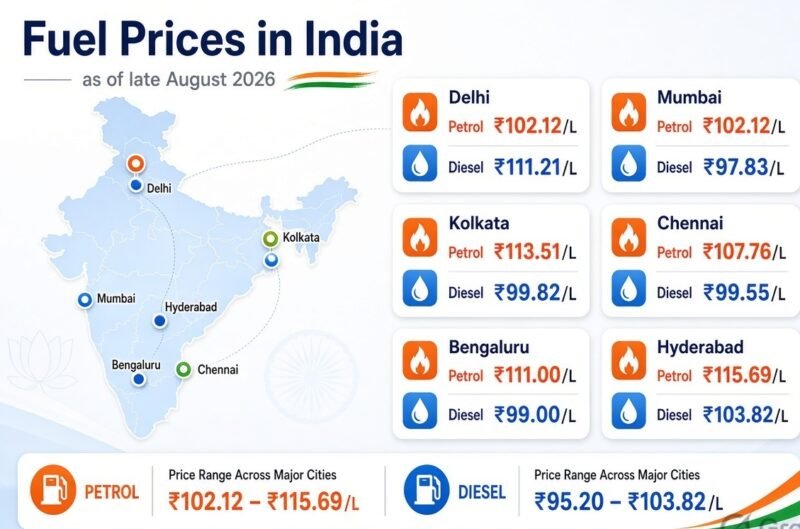
Fuel prices can change over time, so the table below should be treated as a recent reference rather than a permanent rate chart. Recent published data for major metro cities shows the following petrol and diesel prices.
| City | Petrol Price | Diesel Price |
|---|---|---|
| Delhi | ₹102.12/litre | ₹95.20/litre |
| Mumbai | ₹111.21/litre | ₹97.83/litre |
| Kolkata | ₹113.51/litre | ₹99.82/litre |
| Chennai | ₹108.01/litre | ₹99.66/litre |
Fuel prices are subject to revision and may vary by city and state.
Why Do Fuel Prices in India Vary?
The difference in fuel prices in India is influenced by several factors. State-level taxes, transportation costs, dealer margins, and local pricing differences can affect the final retail price.
As a result, the price of petrol or diesel in Delhi may differ from the price in Mumbai, Kolkata, Chennai, or another Indian city. Global crude oil prices and currency movements can also influence the broader cost environment, although retail price changes do not necessarily mirror every movement in crude oil immediately.
How Do Fuel Prices Affect Car Ownership?
Fuel is one of the biggest recurring expenses for many car owners. The higher your monthly driving distance, the more important fuel efficiency becomes.
You can estimate fuel consumption using this formula:
Fuel Required = Total Distance Travelled ÷ Car Mileage
To estimate the cost:
Fuel Cost = Fuel Required × Fuel Price
For example, if your car delivers 15 km/l and you travel 300 km:
Fuel Required = 300 ÷ 15 = 20 litres
If petrol costs ₹102 per litre:
Estimated Fuel Cost = 20 × ₹102 = ₹2,040
The actual amount may vary depending on traffic, driving style, road conditions, and the vehicle’s real-world mileage.
Petrol Prices and Car Running Costs
Petrol cars remain a popular choice among Indian buyers. When calculating the running cost of a petrol vehicle, it is important to consider both the current local petrol price and the car’s real-world fuel efficiency.
A car that delivers better mileage may consume less fuel over the same distance. However, buyers should not select a car based on mileage alone. Purchase price, maintenance requirements, insurance, comfort, performance, and expected usage should also be considered.
Diesel Prices and Long-Distance Driving
Diesel vehicles can be suitable for certain buyers, particularly those with high running requirements, depending on the available models and their ownership needs.
When comparing petrol and diesel cars, calculate the approximate cost per kilometre instead of looking only at the price of one litre of fuel.
Cost Per Kilometre = Fuel Price ÷ Vehicle Mileage
This simple calculation can help you compare the expected running costs of different vehicles.
CNG Prices and Running Costs
CNG is another option for buyers looking to reduce their per-kilometre fuel expenses. The actual benefit depends on local CNG prices, vehicle efficiency, access to filling stations, and daily driving requirements.
CNG efficiency is generally measured in kilometres per kilogram.
CNG Mileage = Distance Travelled ÷ CNG Consumed
Before choosing a CNG vehicle, consider refuelling convenience, available station infrastructure, performance, boot space, and your expected monthly driving distance.
How Rising Fuel Prices Can Influence Car Buying Decisions
Changes in fuel prices in India can affect how buyers compare vehicles. Higher fuel costs may encourage buyers to pay closer attention to mileage, CNG, hybrid technology, and electric cars.
However, choosing the vehicle with the lowest running cost is not always the most economical decision.
For example, a person who drives only a limited distance each month may not benefit enough from a higher-priced hybrid or electric vehicle to offset its initial purchase cost. On the other hand, a high-mileage user may save significantly over time with a more efficient powertrain.
The best option depends on your driving distance, budget, fuel availability, and expected ownership period.
How to Reduce Your Fuel Expenses
Fuel efficiency can be affected by driving habits and vehicle maintenance. Smooth acceleration, avoiding unnecessary idling, maintaining recommended tyre pressure, and following the manufacturer’s service schedule can help reduce unnecessary fuel consumption.
Heavy traffic, aggressive acceleration, frequent hard braking, excessive vehicle load, and poor maintenance can increase fuel usage.
If your car suddenly starts delivering significantly lower mileage, checking the tyres and servicing the vehicle may help identify the reason.
Calculate Monthly Fuel Expenses
A simple fuel cost calculation can help you estimate your monthly car expenses.
Suppose you drive 1,500 km per month, your car delivers 15 km/l, and petrol costs ₹102 per litre.
| Calculation | Result |
|---|---|
| Monthly distance | 1,500 km |
| Average mileage | 15 km/l |
| Estimated fuel required | 100 litres |
| Petrol price | ₹102/litre |
| Estimated monthly fuel cost | ₹10,200 |
This is an estimate, and actual expenses can differ based on real-world mileage and local fuel rates.
How V3Cars Can Help You Understand Car Running Costs
When comparing vehicles, V3Cars can help users explore specifications, mileage information, prices, features, and different fuel options.
Understanding fuel prices in India alongside a car’s mileage can provide a clearer picture of its expected running costs. Buyers should compare fuel expenses with other factors such as purchase price, maintenance, insurance, performance, and long-term ownership requirements.
Frequently Asked Questions
Why are fuel prices different in different Indian cities?
Fuel prices can differ because of state taxes, transportation costs, dealer margins, and other local pricing factors.
How can I calculate my car’s fuel cost?
Divide the distance travelled by your car’s mileage and multiply the estimated fuel required by the current local fuel price.
How often do fuel prices change in India?
Retail fuel rates can be revised under the applicable pricing mechanism, so checking the latest city-specific price is advisable before calculating an exact travel cost.
Which is cheaper to run: petrol, diesel, CNG, or electric?
There is no universal answer. The result depends on local fuel or electricity prices, vehicle efficiency, purchase cost, maintenance, infrastructure, and how much you drive.
How can I estimate my monthly fuel expense?
Calculate your expected monthly distance, divide it by your vehicle’s average mileage, and multiply the result by the current local fuel price.
Conclusion
Fuel prices in India have a direct impact on the cost of owning and operating a vehicle. Since rates vary between locations and can change over time, checking the latest local price is important when calculating fuel expenses.
Before buying a car, compare expected fuel costs along with mileage, purchase price, maintenance, performance, and your regular driving requirements. By researching different vehicles and their running costs with V3Cars, you can make a more practical and informed decision.
