

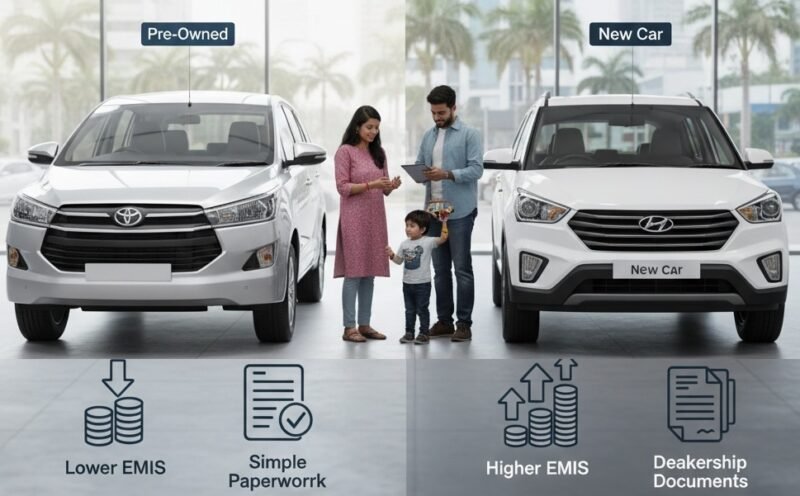
Buying a car is more than just a purchase; for many Indian families, it’s a milestone. It signifies progress, convenience, and the freedom to travel together. However, standing between you and that dream drive is a crucial financial decision: determining how to fund it.
When you walk into a showroom or browse online listings, you aren’t just choosing between a sparkling new sedan or a sturdy pre-owned SUV. You are also choosing between two distinct financial products. The debate of used car loan vs new car loan is common, yet the answer varies significantly based on your financial health and long-term goals.
While a new car brings the allure of the latest tech and that unbeatable “new car smell,” a used car promises value for money and slower depreciation. But how do the loans for these two options stack up? Understanding the nuances of interest rates, down payments, and eligibility criteria is essential to ensure your dream car doesn’t become a financial burden.
This guide will break down everything you need to know, helping you navigate the HDFC car loan process or any other lender’s requirements with confidence.
Key Factors That Differentiate Car Loans
Before diving into the specifics of each loan type, it is vital to understand the parameters that lenders use to evaluate these loans. The dynamics of lending change depending on the age of the asset.
Interest Rates
The most significant difference lies here. New car loans generally come with lower interest rates compared to used car loans. Lenders perceive new cars as lower-risk assets because they have a higher resale value and no history of mechanical issues. Conversely, used cars carry a higher risk profile, often resulting in interest rates that are 2% to 6% higher.
Loan Tenure
New car loans offer flexibility, often extending up to 7 or even 8 years. This allows borrowers to spread out their payments, resulting in lower monthly EMIs. Used car loans typically have shorter tenures, usually capped at 5 years, or restricted by the age of the vehicle (e.g., loan tenure + age of car cannot exceed 8 years).
Loan-to-Value (LTV) Ratio
For a new car, banks might finance up to 90% or even 100% of the ex-showroom price. For used cars, the LTV ratio is generally lower, often covering only 60% to 80% of the used car valuation guide price, meaning you will need a larger down payment.
The Case for New Car Loans
For first-time buyers, the path of least resistance is often a new car. The process is streamlined, and banks are eager to lend.
Benefits of Financing a New Car
- Lowest Interest Rate Car Loan 2026 Projections: While rates fluctuate, new car loans consistently offer the most competitive rates in the market. If you have a high credit score (750+), you can negotiate for the absolute rock-bottom rates.
- Higher Loan Amount: As mentioned, you can get funding for almost the entire cost of the car, reducing your upfront financial burden.
- Simplified Documentation: Since the dealer often handles the tie-up with banks, the paperwork is minimal.
The Drawbacks
The primary downside isn’t the loan itself, but the asset. A new car depreciates rapidly—often losing 20-30% of its value in the first year. While your EMI remains constant, the car’s value drops, meaning you might owe more than the car is worth in the early years of the loan.
Eligibility and Documentation
- Eligibility: Generally requires a stable income (salaried or self-employed), a credit score above 700, and age between 21 to 60 years.
- Documents: Identity proof, address proof, income proof (salary slips/ITR), and bank statements.
The Case for Pre-Owned Car Loans
The pre-owned market in India has exploded in quality and quantity. Buying used allows you to upgrade segments—getting a sedan for the price of a hatchback.
Benefits of Financing a Used Car
- Lower Principal Amount: Since a used car costs significantly less than a new one, the total loan amount is lower. Even with a higher interest rate, your total interest payout might be lower in absolute terms simply because the principal is smaller.
- Slower Depreciation: You avoid that initial steep drop in value. The car holds its price better during the loan tenure.
- Quick Processing: With digitized valuation tools, many modern lenders disburse used car loans within 24-48 hours.
The Drawbacks
- Higher Interest Rates: You will pay a premium on the interest rate. It is crucial to use a car loan EMI calculator to see if the higher rate makes the monthly payments uncomfortable.
- Maintenance Costs: An older car may require more repairs, which is an out-of-pocket expense distinct from your EMI.
Eligibility and Documentation
- Eligibility: Similar to new cars, but lenders are stricter about the age and condition of the car. The car usually shouldn’t be more than 5-7 years old at the time of purchase.
- Documents: In addition to personal KYC and income documents, you will need the RC copy of the old owner and a valuation report.
Making the Right Financial Decision
So, how do you decide? It comes down to analyzing your cash flow and total cost of ownership.
Scenario A: The New Car Buyer
If you plan to keep the car for 7-10 years, a new car loan makes sense. The lower interest rate and long tenure allow for manageable monthly cash flow. You also get the peace of mind of a manufacturer’s warranty.
Scenario B: The Value Seeker
If you like changing cars every 3-4 years, or if you are on a tight budget but need a larger vehicle for your family, a used car loan is superior. You take a smaller loan, pay it off quickly, and lose less money on depreciation.
Practical Tip: Before applying, check the HDFC car loan process or your preferred bank’s website. Many banks offer pre-approved loans for existing customers, which can bypass much of the paperwork for both new and used vehicles.
Final Recommendation: Balancing Heart and Wallet
The battle of used car loan vs new car loan doesn’t have a single winner; it depends entirely on your battlefield.
If you value warranty, low maintenance, and lower interest rates, and you have the budget for a higher principal amount, go for the new car loan. It is the safer, more predictable route for first-time buyers.
However, if you are financially savvy and understand that a car is a depreciating asset, a used car loan allows you to buy a premium vehicle for a fraction of the price. Ensure you check the used car valuation guide to ensure you aren’t overpaying for the vehicle itself, as the bank will only lend based on the fair market value.
Analyze your budget, use an EMI calculator, and choose the road that keeps your finances as smooth as your drive.
Frequently Asked Questions (FAQs)
1. Can I get a tax benefit on a car loan in India?
For salaried individuals, car loans generally do not offer tax benefits. However, if you are a self-employed professional or business owner and use the car for business purposes, you can claim the interest paid as a business expense, thereby reducing your taxable profit. Depreciation on the car can also be claimed.
2. How does the ‘lowest interest rate car loan 2026’ trend look for used cars?
While it is difficult to predict exact rates for 2026, the gap between new and used car loan interest rates is narrowing. As the organized pre-owned car market grows and valuation becomes more scientific, lenders are becoming more comfortable offering competitive rates on certified used cars.
3. What is a “hypothecation” in a car loan?
Hypothecation means that while you possess and use the car, the bank technically owns it until the loan is paid off. Your Registration Certificate (RC) will mention that the car is hypothecated to your bank. Once you repay the loan, you must get this removed from the RC.
4. Is the down payment higher for used car loans?
Yes, typically. For a new car, you might pay 10-15% as a down payment. For a used car, banks may only finance 70-80% of the valuation amount, requiring you to arrange 20-30% of the cost upfront.
Read Also: How to Change the Tyre: A Step-by-Step Guide
