


The alarm goes off. It’s dark outside, your duvet is incredibly warm, and the gym feels like it’s a million miles away. We have all been there. Sometimes, the mental hurdle of getting dressed, packing a bag, and commuting to a fitness center is just too high. But skipping a workout entirely often leads to guilt and lethargy that follows you for the rest of the day.
Here is the good news: you don’t actually have to leave your covers to get your blood flowing. There are effective exercises you can do from your bed that engage your core, wake up your muscles, and improve your flexibility. While a mattress workout might not replace heavy deadlifts or a 5k run, it is significantly better than hitting snooze for the fourth time.
Whether you are looking for a gentle morning wake-up routine or a way to wind down before sleep, these movements prove that fitness doesn’t always require sneakers.
Why “Bed Yoga” and Mattress Pilates Are gaining Popularity
The concept of working out in bed—often dubbed “cozy cardio” or “mattress pilates” on social media—is more than just a trend for the lazy. It is a legitimate way to incorporate movement into a sedentary lifestyle.
When you exercise on a soft surface like a mattress, your body has to work slightly harder to maintain balance compared to a solid floor. This instability forces your stabilizer muscles, particularly in your core and ankles, to engage more deeply. Furthermore, removing the friction of getting to a gym eliminates the biggest barrier to exercise: consistency.
If you are recovering from an injury, dealing with chronic fatigue, or simply having a slow morning, these low-impact moves are accessible and effective.
The 6 Best Exercises You Can Do From Your Bed
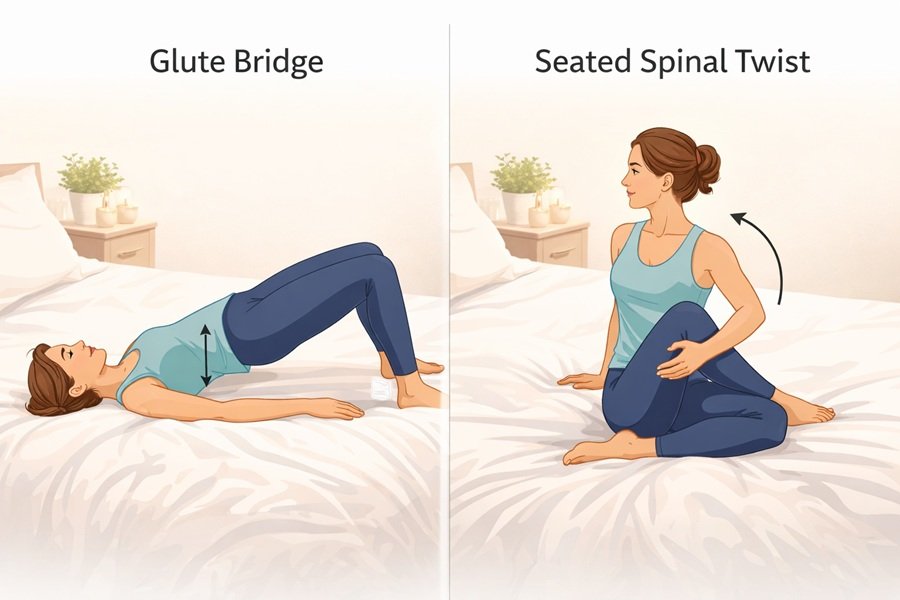
Ready to give it a try? Push the heavy blankets aside (but keep the pillow handy) and try this circuit. Aim for 10 to 15 repetitions of each move.
1. Supine Glute Bridges
This is a fantastic way to wake up your posterior chain—specifically your glutes and hamstrings—which often go dormant after a night of sleep.
How to do it:
- Lie on your back with your knees bent and feet flat on the mattress, hip-width apart.
- Place your arms by your sides, palms facing down for stability.
- Press through your heels to lift your hips toward the ceiling. Squeeze your glutes at the top.
- Ensure your body forms a straight line from shoulders to knees. Avoid arching your lower back.
- Slowly lower your hips back down to the mattress.
2. The “Dead Bug” (Core Stabilizer)
Despite the funny name, this is a serious core burner. The soft mattress adds an extra challenge to keeping your torso stable.
How to do it:
- Lie on your back and extend your arms straight up toward the ceiling.
- Lift your legs so your knees are bent at 90 degrees (tabletop position).
- Engage your core by pressing your lower back into the mattress.
- Slowly lower your right arm behind your head while simultaneously extending your left leg straight out. Keep them hovering just above the bed.
- Return to the starting position and switch sides (left arm, right leg).
3. Side-Lying Leg Lifts
This exercise targets the gluteus medius and outer thighs (abductors), areas that are crucial for hip stability but often neglected.
How to do it:
- Lie on your right side with your legs stacked on top of each other. You can prop your head up with your hand or rest it on your arm.
- Keep your legs straight and toes flexed.
- Lift your top leg (left leg) as high as comfortable without rotating your hips backward.
- Pause briefly at the top, then lower it slowly without letting it rest completely on the bottom leg.
- Complete your reps, then roll over to the other side.
4. Pillow Squeezes (Adductors)
Don’t just lay on your pillow—use it. This move targets the inner thighs, which helps stabilize your pelvis and knees.
How to do it:
- Lie on your back with knees bent and feet flat on the bed (similar to the Glute Bridge position).
- Place a thick pillow (or folded duvet) between your knees.
- Squeeze the pillow as hard as you can with your knees, holding the tension for 3 to 5 seconds.
- Release the tension without dropping the pillow.
- Repeat. You should feel this in your inner thighs immediately.
5. Seated Spinal Twists
After engaging the muscles, it is vital to mobilize the spine. This stretch helps wring out tension from sleeping in a weird position and aids digestion.
How to do it:
- Sit up in the middle of your bed with your legs crossed (easy pose).
- Sit tall, lengthening your spine as if a string is pulling the top of your head upward.
- Inhale, and as you exhale, gently twist your torso to the right.
- Place your left hand on your right knee and your right hand behind you on the bed for support.
- Look over your right shoulder. Hold for 3 deep breaths.
- Return to center and repeat on the left side.
6. Cobra Stretch (Back Extension)
Counteract the hunching posture we often adopt while sleeping (or looking at phones) with this chest-opening move.
How to do it:
- Roll over onto your stomach. Extend your legs straight back with the tops of your feet resting on the mattress.
- Place your hands under your shoulders, elbows tucked close to your ribs.
- Press into your hands to lift your head and chest off the bed. Keep your gaze forward or slightly up.
- Keep your hips grounded on the mattress.
- Hold for a few seconds, feeling the stretch in your abs and chest, then lower back down.
Tips for Maximizing Your “Lazy” Workout
Just because you are in pajamas doesn’t mean form goes out the window. To get the most out of these exercises you can do from your bed, keep these tips in mind:
- Mind Your Wrists: Mattresses are soft, which can be hard on wrists during moves like planks or push-ups. If you experience pain, perform exercises on your forearms or make a fist to keep wrists neutral.
- Don’t Rush: Momentum is not your friend here. Because the surface is unstable, slow and controlled movements will recruit more muscle fibers.
- Breathe Intentionally: It is easy to hold your breath when concentrating. Try to exhale on the exertion (the hard part of the move) and inhale on the release.
- Create a Routine: Try doing this sequence immediately after your alarm goes off. It serves as a physiological signal to your brain that the sleep cycle is over and the day has begun.
Start Your Day with Intentional Movement
Fitness isn’t always about high-intensity interval training or heavy weights. It is about the relationship you have with your body. By choosing to move, even in a small way, you are prioritizing your health over the temptation of staying stagnant.
These exercises represent a bridge between rest and activity. They are accessible, free, and require zero equipment. So, the next time the gym feels impossible, remember that you have a gym right beneath your sheets. Commit to just five minutes tomorrow morning—your body will thank you for it.
Frequently Asked Questions About Bed Workouts
- Is exercising in bed actually effective?
Yes, absolutely. While it won’t burn as many calories as a HIIT class, bed exercises are excellent for building core stability, improving flexibility, and maintaining joint mobility. They are particularly effective for muscle activation and waking up the nervous system. - Can I lose weight by doing exercises in bed?
Weight loss is primarily driven by a calorie deficit (burning more calories than you consume). Bed exercises are generally low-intensity, so the calorie burn is modest. However, they contribute to your overall daily activity (NEAT) and can help tone muscles, which improves metabolism over time. - 3. Is it better to do these exercises in the morning or at night?
Both have benefits! Doing these exercises in the morning helps wake up the brain, boosts circulation, and reduces morning stiffness. Doing them at night can help relieve muscle tension accumulated throughout the day and promote better sleep quality.
Must Read: Transform Your Morning Brew: Healthy Hot Drinks That Taste Amazing
