

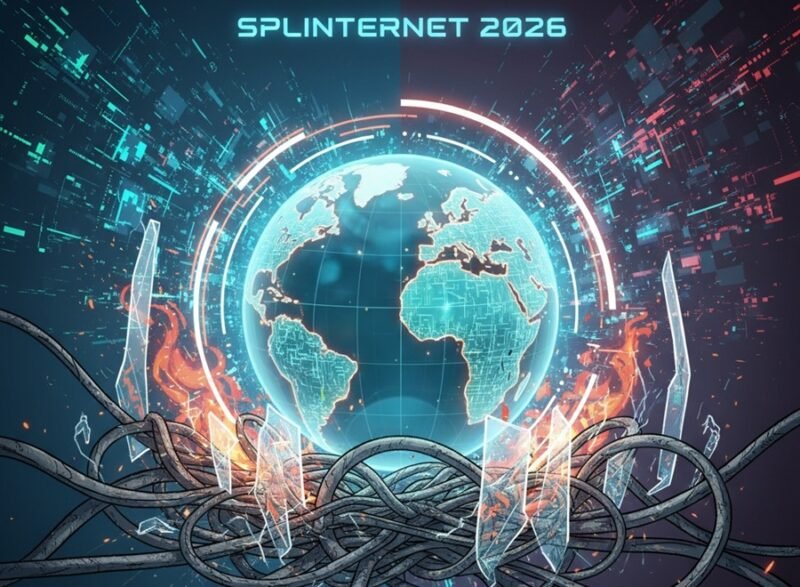
The internet was once hailed as the great equalizer—a borderless digital commons where information flowed freely from one corner of the globe to another. We believed in a singular, interconnected web that would unite humanity. But that idealistic vision is rapidly eroding. In its place, we are witnessing the rise of the “Splinternet”—a fragmented collection of national intranets, walled off by governments and separated by conflicting regulations.
This phenomenon, often called the balkanization of the web, represents a fundamental shift in how we connect, trade, and communicate. As we look ahead to Splinternet 2026, the cracks in the digital foundation are widening. Nations are erecting digital borders as aggressively as physical ones, asserting control over data and content within their jurisdictions. For tech policymakers, business leaders, and privacy advocates, understanding this fracturing is no longer optional; it is essential for survival in a divided digital world.
From Global Village to Gated Communities
To understand where we are going, we must first look back at the original architecture of the web. The early internet was built on open protocols—TCP/IP—designed to ensure that a computer in New York could seamlessly talk to one in Nairobi or Tokyo. It was a tool of soft power, promoting democratic values and free speech.
However, the seeds of fragmentation were sown early. As the internet matured, governments realized that an unregulated flow of information posed risks to national security, social stability, and political control. What began as minor content filtering has metastasized into sophisticated systems of digital sovereignty. The dream of a “global village” is being replaced by a reality of gated digital communities, where your location dictates what you see, what apps you can use, and where your data lives.
The Forces Driving Digital Fragmentation
Several powerful currents are pulling the web apart. This isn’t just about censorship; it’s a complex interplay of economics, security, and politics.
Geopolitical Tensions
The internet has become a new battlefield. Cyber-balkanization is largely driven by distrust between major global powers. The United States, Russia, China, and the European Union are increasingly viewing technology stacks as strategic assets or vulnerabilities. Sanctions and trade wars now extend to software and hardware, forcing nations to develop domestic alternatives to foreign tech, further isolating their digital ecosystems.
Data Sovereignty
Data is the new oil, and every nation wants to secure its reserves. Countries are enacting strict data localization laws, requiring that data generated within their borders stays there. This concept of a “sovereign internet” complicates operations for multinational corporations. They can no longer simply store data in a central cloud; they must navigate a patchwork of local servers and compliance requirements.
Regulatory Divergence
The EU’s GDPR set a high standard for privacy, but other regions are developing their own, often conflicting, frameworks. This regulatory divergence creates friction. A startup in India faces different rules than a tech giant in Silicon Valley. These disparate legal environments encourage companies to ring-fence their services, creating different versions of the internet for different users.
The Great Firewall and Beyond: Case Studies in Control
The most prominent example of this fragmentation is undoubtedly China. The Great Firewall is not just a barrier; it is a sophisticated ecosystem. It blocks foreign platforms like Google and Facebook while nurturing domestic giants like WeChat and Baidu. This creates a parallel digital universe where the norms of the open web do not apply.
But China is not alone. Russia has tested its “Runet,” effectively disconnecting from the global internet to ensure it can function independently in times of conflict. Iran develops its National Information Network to control dissent. Even democratic nations are contributing to the trend. The EU’s aggressive pursuit of tech regulation, while well-intentioned for privacy, inadvertently encourages a splinternet by forcing global platforms to geo-block content to avoid massive fines.
The Implications of a Broken Web
The consequences of this fracture extend far beyond not being able to access certain websites.
Impact on Global Business
For international business owners, the Splinternet is a logistical nightmare. The cost of compliance skyrockets when you must adhere to dozens of conflicting digital regimes. Supply chains, which rely on seamless data flow, face disruption. A fractured web stifles innovation, as startups lose access to a truly global market from day one.
Cybersecurity Risks
Ironically, while nations claim data sovereignty improves security, fragmentation often weakens it. A balkanized web relies on divergent standards, creating security gaps that bad actors can exploit. Furthermore, when the global community cannot share threat intelligence freely due to political barriers, our collective defense against cyberattacks suffers.
Human Rights and Privacy
Perhaps the gravest cost is to human rights. A sovereign internet is often a surveillance state. When governments control the infrastructure, they control the narrative. Digital privacy advocates warn that without the checks and balances of a global internet, marginalized groups lose a vital platform, and state propaganda becomes the only available truth.
Splinternet 2026: What the Future Holds
If current trends continue, what does the digital landscape look like in 2026?
| Model | Key Driver | Geographic Influence |
| Silicon Valley Model | Market & Data Capital | USA & many Western nations |
| Sovereign Model | State Control & Security | China (Great Firewall), Russia (Runet) |
| GDPR Model | Privacy & Human Rights | European Union |
We may see a world divided into three distinct “internets.”
- The Open Web (US-led): Still largely free but increasingly commercialized and surveilled by private corporations.
- The Authoritarian Web (China/Russia-led): Highly controlled, state-monitored, and restricted, prioritizing social stability over individual freedom.
- The Regulated Web (EU-led): A middle ground focused heavily on consumer privacy and antitrust, creating high barriers to entry for non-compliant tech.
Technologically, we might see the rise of “splinter-nets” within apps themselves. Super-apps that encompass messaging, payments, and browsing could become closed loops, further reducing reliance on the open web. We may also see the hardware layer fracture, with devices manufactured in one bloc being incompatible with the networks of another.
Can We Bridge the Divide?
Is total fragmentation inevitable? Not necessarily, but mitigation requires concerted effort.
- International Digital Treaties: Just as we have trade agreements, we need digital accords that establish baseline norms for data flow and cybersecurity, respecting sovereignty without destroying connectivity.
- Decentralized Technologies: Blockchain and decentralized web protocols (Web3) offer a potential technical workaround to state-controlled checkpoints, though they face significant adoption and regulatory hurdles.
- Corporate Diplomacy: Tech giants often find themselves acting as diplomats. By negotiating standards that satisfy multiple jurisdictions, they can help keep the digital bridges open.
Navigating the Fractured Future
The Splinternet is not a theoretical dystopia; it is the unfolding reality. As we approach Splinternet 2026, the dream of a singular, universal cyberspace is fading. For businesses, this means preparing for a more complex, costly operating environment. For policymakers, it means balancing security with the immense value of openness. And for citizens, it is a stark reminder that the freedom to connect is fragile. The walls are going up; knowing where they are and how to navigate them is the new literacy of the digital age.
Read Also: The Future of AI in Finance: Trends to Watch
