

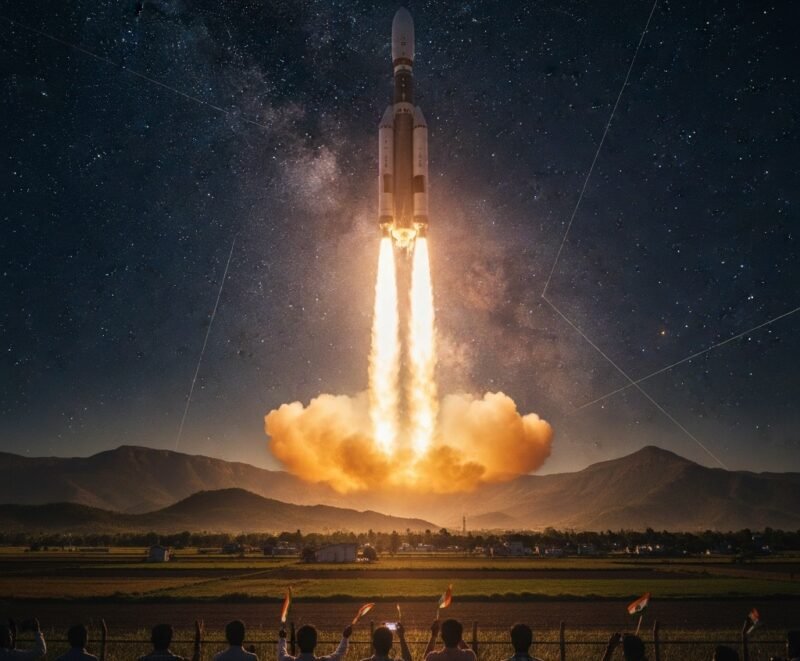
The roar of engines at the Satish Dhawan Space Centre in Sriharikota is a sound every Indian takes pride in. Recently, that sound signaled a massive leap forward for the Indian Space Research Organisation (ISRO). If you have been tracking the headlines on rajkotupdates.news:lvm3 m2/oneweb india-1, you already know that this wasn’t just another launch. It was a historic milestone that positioned India as a serious heavyweight player in the global commercial satellite market.
This mission, officially designated as LVM3-M2/OneWeb India-1, marked the entry of ISRO’s heaviest rocket into the commercial arena. For students, competitive exam aspirants, and science enthusiasts, understanding the technical and strategic nuances of this mission is essential. This guide breaks down everything you need to know about the launch that put 36 broadband satellites into Low Earth Orbit (LEO) and opened a new chapter for NewSpace India Limited (NSIL).
The Mission Overview: LVM3-M2/OneWeb India-1
The LVM3-M2 mission was the first dedicated commercial mission for the LVM3 (Launch Vehicle Mark 3). Historically, ISRO has relied on its trusty workhorse, the PSLV (Polar Satellite Launch Vehicle), for commercial launches. However, the LVM3 offers significantly higher payload capacity, allowing India to compete for heavier and more complex commercial contracts.
This mission was executed under a commercial arrangement between NewSpace India Limited (NSIL), a central public sector enterprise under the Department of Space, and OneWeb, a UK-based communications company.
Key Mission Objectives
- Payload Deployment: The primary goal was to deploy 36 Gen-1 satellites from OneWeb.
- Orbit Injection: The satellites were to be placed into a circular Low Earth Orbit (LEO) at an altitude of approximately 601 kilometers.
- Commercial Viability: Proving the LVM3 capability for multi-satellite deployment in a single mission.
Understanding the “Baahubali” Rocket: LVM3
For years, the GSLV Mk III was the technical name for ISRO’s heaviest launcher. It has now been re-designated as LVM3 (Launch Vehicle Mark 3). Often affectionately called “Baahubali” due to its ability to lift heavy loads, this rocket is a three-stage behemoth.
Technical Specifications
- Solid Stage (S200): Two solid strap-on motors, which are among the largest solid boosters in the world.
- Liquid Stage (L110): A core liquid stage powered by two Vikas engines.
- Cryogenic Stage (C25): The upper stage, powered by the indigenous CE-20 cryogenic engine, which is crucial for the final thrust into orbit.
The success of the rajkotupdates.news:lvm3 m2/oneweb india-1 story lies in the reliability of this vehicle. By flawlessly executing this mission, the LVM3 demonstrated it is not just for government missions like Chandrayaan or Gaganyaan, but is ready for the global market.
Why OneWeb? The Connectivity Revolution
One-Web is a global communications ne8work powered from space. Their goal is to deliver connectivity for governments, businesses, and communities. They are building a constellation of Low Earth Orbit satellites to provide high-speed, low-latency broadband connectivity.
This partnership is significant because OneWeb is backed by India’s Bharti Enterprises, making it a distinct example of India’s corporate footprint in the global space economy. The satellites launched are designed to provide internet access to remote and underserved regions, bridging the digital divide that still exists in many parts of the world.
Strategic Importance for India
This launch was not merely a technical success; it was a geopolitical and economic statement. Here is why this mission matters for the future of the Indian space sector:
1. Strengthening the Commercial Arm (NSIL)
NewSpace India Limited (NSIL) was established to monetize ISRO’s research and capabilities. By securing a contract for such a heavy payload, NSIL has demonstrated that it can handle complex, high-value contracts. This generates foreign exchange revenue and boosts the Indian economy.
2. Diversifying Launch Capabilities
Until this mission, commercial clients with heavy satellites had to look to European or American launch providers. The LVM3 offers a cost-effective and reliable alternative. It breaks the monopoly of other space agencies and private companies in the heavy-lift category.
3. Boosting “Atmanirbhar Bharat”
The entire mission, from the cryogenic engine to the launch infrastructure, highlights indigenous technology. It proves that India is self-reliant in critical space technologies and does not need to depend on foreign launch vehicles for its own heavy satellites.
Key Takeaways for Competitive Exams (UPSC/SSC)
If you are an aspirant preparing for civil services or other competitive exams, the rajkotupdates.news:lvm3 m2/oneweb india-1 topic is a potential goldmine for questions regarding Science & Technology and Current Affairs.
Here are the bullet points you need to memorize:
- Vehicle Name: LVM3 (Launch Vehicle Mark 3), previously known as GSLV Mk III.
- Mission Type: First dedicated commercial mission for LVM3.
- Agency: Executed by NSIL (NewSpace India Limited) for OneWeb.
- Payload: 36 OneWeb Gen-1 satellites.
- Total Payload Mass: Approximately 5,796 kg (The heaviest payload launched by ISRO to date).
- Orbit: Low Earth Orbit (LEO).
- Significance: Marks India’s entry into the global commercial heavy launch market.
Conclusion
The successful launch covered in the rajkotupdates.news:lvm3 m2/oneweb india-1 reports is a testament to the brilliance of ISRO’s scientists and engineers. It marks a transition from purely research-based missions to aggressive commercial expansion. As the LVM3 continues to roar into the skies, it carries with it the aspirations of a nation ready to lead the world in space technology.
For space enthusiasts and students alike, this is just the beginning. With the upcoming Gaganyaan (human spaceflight) mission also utilizing the LVM3, the “Baahubali” rocket is set to become an icon of Indian innovation.
Keep watching the skies and stay updated with official ISRO announcements to witness history in the making.
Frequently Asked Questions (FAQs)
What is the full form of LVM3?
LVM3 stands for Launch Vehicle Mark 3. It was previously referred to as the GSLV Mk III (Geosynchronous Satellite Launch Vehicle Mark III). It is ISRO’s most powerful launcher, capable of launching 4-ton class satellites into Geosynchronous Transfer Orbit (GTO).
How many satellites were launched in the LVM3 M2 mission?
The mission successfully deployed 36 satellites belonging to OneWeb, a UK-based communication company. This was a significant milestone as it was a complex maneuver to release satellites in precise phases to avoid collisions.
What is the role of NSIL in this launch?
NewSpace India Limited (NSIL) is a Central Public Sector Enterprise (CPSE) under the Department of Space. It is the commercial arm of ISRO. NSIL was responsible for the commercial arrangement and execution of this mission, marking a shift toward demand-driven models in the Indian space sector.
Why is this mission important for competitive exams?
This mission is crucial for exams like UPSC and SSC because it covers multiple important themes: Indigenization of technology (Atmanirbhar Bharat), the role of PSUs (NSIL), and advancements in Science and Technology (Cryogenic engines and LEO satellite constellations).
Read Also: rajkotupdates.news : Famous Singer Lata Mangeshkar Has Died
