

There is a specific kind of silence that every driver dreads. It’s not the quiet of a peaceful morning commute or the hush of an empty garage. It’s the clicking sound—or worse, the absolute nothingness—that happens when you turn your key in the ignition.
As a certified roadside assistance technician, I’ve heard that silence thousands of times. I’ve arrived at shopping mall parking lots, driveways, and highway shoulders to find stranded motorists staring helplessly at a dead battery. Often, they have jumper cables in the trunk but are too afraid to use them.
And honestly? That fear is healthy.
Jump-starting a car isn’t just about connecting wire A to wire B. Modern vehicles are complex computers on wheels. One wrong move with a set of jumper cables can fry your Engine Control Unit (ECU), blow fuses, or in rare, extreme cases, cause a battery explosion due to escaping hydrogen gas.
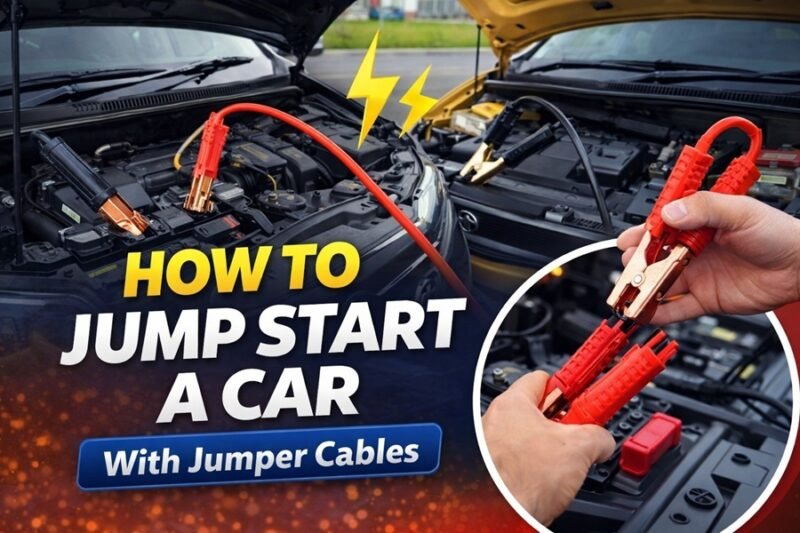
But don’t let that stop you. When done correctly, jump-starting is a safe, simple, and essential skill. In this guide, I will walk you through the proper way to jump start a car, explaining the exact jumper cable connection order you need to follow to get back on the road safely.
Safety First: Before You Connect Anything
Before we even touch the cables, we need to assess the situation. Not every dead car can—or should—be jump-started.
1. Check the Battery Condition
Pop the hood and look at the battery. If you see cracks in the casing, leaking fluid, or if the battery looks swollen or bloated, do not attempt to jump start it. A damaged battery can explode if subjected to a surge of power. Call a tow truck or a professional immediately.
2. Locate the Battery
In most cars, the battery is under the hood. However, some manufacturers (like BMW or Dodge) place the battery in the trunk or under a seat to distribute weight. If you can’t find it, look for remote positive (+) and negative (-) terminals under the hood. These are specifically designed for jump-starting.
3. Identify Positive and Negative
This is critical.
- Positive (+): Usually red, marked with a plus sign (+), and often has a red plastic cover.
- Negative (-): Usually black, marked with a minus sign (-).
4. Position the Vehicles
Park the working car (the donor) close enough to the dead car so the cables can reach, but do not let the vehicles touch. If the cars are touching, a dangerous ground path could be created, leading to sparks or electrical damage. Turn off both cars and remove the keys from the ignition.
The Equipment: What You Need
- Jumper Cables: Use a heavy-duty set (4 or 6 gauge) if possible. Thicker cables transfer power more efficiently.
- Safety Glasses: Batteries contain acid and can emit gas. Eye protection is smart.
- Gloves: To protect against grime and minor sparks.
The Golden Rule: Jumper Cable Connection Order
If you take only one thing away from this article, let it be this sequence. The order in which you attach the cables matters immensely for safety.
We use the “Red-Dead, Red-Alive, Black-Alive, Black-Metal” method.
Here is the correct connection sequence:
- Red (+) to Dead: Connect the red clamp to the positive terminal of the dead battery.
- Red (+) to Alive: Connect the other red clamp to the positive terminal of the working (donor) battery.
- Black (-) to Alive: Connect the black clamp to the negative terminal of the working battery.
- Black (-) to Ground: Connect the remaining black clamp to an unpainted metal surface on the dead car’s engine block.
Why Ground to Metal?
You might wonder why we don’t connect the final black clamp to the negative terminal of the dead battery.
Lead-acid batteries release hydrogen gas when they charge or discharge rapidly. Hydrogen is highly flammable. If you connect the final cable to the negative terminal, it almost always creates a spark. If that spark occurs right next to the battery vent where gas is escaping, it could ignite the gas.
By connecting to a solid piece of metal on the engine block (like a bolt or bracket) away from the battery, any spark generated happens far away from the explosive gas.
Step-by-Step Guide: How to Jump Start a Car With Cables
Now that you understand the theory and safety, let’s go through the physical process. Follow these steps precisely to avoid damage to your vehicle’s electronics.
Step 1: Prepare the Vehicles
Ensure both cars are in Park (or Neutral for manual transmissions) with parking brakes engaged. Turn off lights, radios, A/C, and any other electrical accessories to maximize power for the starter. Unplug phone chargers.
Step 2: Connect the Positive Cables
Take your jumper cables and separate the red and black clamps so they don’t accidentally touch each other.
- Attach one Red (+) clamp to the positive terminal of the Dead Battery. Wiggle it slightly to ensure it bites into the metal for a good connection.
- Walk over to the donor car. Attach the other Red (+) clamp to the positive terminal of the Working Battery.
Step 3: Connect the Negative Cables
- Still at the donor car, attach one Black (-) clamp to the negative terminal of the Working Battery.
- Walk back to the dead car. Do not attach the final black clamp to the battery. Instead, find an unpainted metal surface on the engine block or chassis. A heavy bolt on the engine or a specialized grounding point is ideal. Connect the Black (-) clamp there.
Step 4: Start the Working Car
Start the engine of the donor vehicle. Let it idle for 2-3 minutes. This allows the alternator of the working car to charge its own battery and send some surface charge to the dead battery. If the dead battery is extremely drained, you might want to rev the donor engine slightly (to about 1500-2000 RPM) to increase the alternator’s output.
Step 5: Start the Dead Car
Now, attempt to start the car with the dead battery.
- If it starts: Great! Leave the engine running.
- If it clicks but doesn’t start: Check your connections. The clamps might not be making good contact with the terminals. Twist them slightly and try again.
- If it does nothing: The battery might be completely beyond saving, or there could be a deeper issue like a bad starter or alternator.
- If it cranks slowly: Stop. Wait another 5 minutes with the donor car running to let the battery build up more charge, then try again.
Step 6: Disconnect Cables in Reverse Order
Once the dead car is running, do not shut it off! You need to remove the cables safely. We do this in the exact reverse order of how we put them on to prevent short circuits.
Removal Order:
- Black (-) from Ground: Remove the negative clamp from the metal surface on the previously dead car.
- Black (-) from Alive: Remove the negative clamp from the donor car.
- Red (+) from Alive: Remove the positive clamp from the donor car.
- Red (+) from Dead: Remove the positive clamp from the previously dead car.
Keep the previously dead car running for at least 20-30 minutes. You need to drive it to allow the alternator to recharge the battery. If you shut it off immediately, it likely won’t start again.
Troubleshooting: When the Jump Doesn’t Work
Sometimes, even when you follow the proper way to jump start a car, the engine refuses to turn over. Here is what might be happening.
The “Clicking” Noise
If you turn the key and hear a rapid click-click-click, it usually means the starter solenoid is engaging, but there isn’t enough amperage to turn the engine.
- Fix: The connections might be loose or dirty. Wiggle the clamps to cut through any corrosion. Let the donor car run longer to charge the dead battery.
The Single Click
A single, loud click usually points to a bad starter motor or a seized engine, though it can sometimes be a connection issue.
- Fix: Check connections first. If they are good and the battery has charge, you may need a tow to a mechanic for a starter replacement.
No Lights, No Sound
If the dashboard lights don’t even flicker when you turn the key, the battery is completely dead (0 volts) or the main fuse has blown.
- Fix: Check the main fuse box. If the fuses are intact, the battery may have an internal short and cannot accept a charge. You will likely need a new battery installed on the spot.
The Car Starts, Then Dies Immediately
This often indicates a bad alternator. Once the jumper cables are removed, the car relies on its alternator to produce electricity. If the alternator is dead, the car will stall as soon as the external power source is disconnected.
- Fix: This is a job for a mechanic. You will need a tow.
Modern Cars and Electronics Risks
I touched on this earlier, but it bears repeating. Vehicles manufactured after 2000 generally have sensitive electronics. A sudden voltage spike—which can happen if cables are connected incorrectly or removed carelessly—can damage the ECU (the car’s brain), the entertainment system, or the airbag control module.
To mitigate this:
- Turn on the headlights of the dead car just before disconnecting the cables. This can help absorb any voltage spike that occurs when the circuit is broken. (Turn them off again once cables are clear).
- Consider a Jump Pack: As a professional, I rarely use cables anymore. I use a portable lithium-ion jump starter. They have built-in safety features like reverse polarity protection, meaning if you hook them up backward, the unit simply won’t turn on rather than sparking. They are safer for modern electronics and easier to use.
Frequently Asked Questions
Can you get electrocuted jump-starting a car?
Car batteries are 12 volts DC. You cannot get electrocuted (as in, shocked to death) by touching the terminals with your bare hands. However, you can get burned if your metal ring or watch touches both terminals at once, causing a short circuit. The metal will become red-hot instantly. Always remove jewelry before working on a car battery.
How long does it take to jump start a car?
Usually, the process takes about 5 to 10 minutes. If the dead battery is very old or it is extremely cold outside, you may need to let the cars stay connected for up to 15 minutes to transfer enough charge.
Can I jump start a car in the rain?
Yes, it is generally safe to jump start a car in the rain, provided you aren’t submerged in water. The 12V system is not high enough voltage to arc through rain to your body. However, try to keep the connection points as dry as possible to ensure a good spark.
What if the cables get hot?
If the jumper cables feel hot to the touch, disconnect them immediately (safety first!). This means either the cables are too thin for the amount of current being drawn, or there is a bad connection creating resistance. Let them cool down and check your connections.
Final Thoughts: Don’t Get Stranded Twice
Knowing how to jump start a car with cables is a skill every driver should have, but it is a temporary fix. A jump start gets you home; it doesn’t fix the underlying problem.
If your battery is more than three years old, or if you find yourself needing a jump start more than once, it is time for a replacement. Batteries are chemical storage devices that degrade over time. No amount of jump-starting can fix a battery that has lost its ability to hold a charge.
Drive safe, keep those cables in your trunk, and remember: Red to dead, red to alive, black to alive, black to metal.
Related Post: How to Jump Start a Car Safely: A Mechanic’s Step-by-Step Guide
