

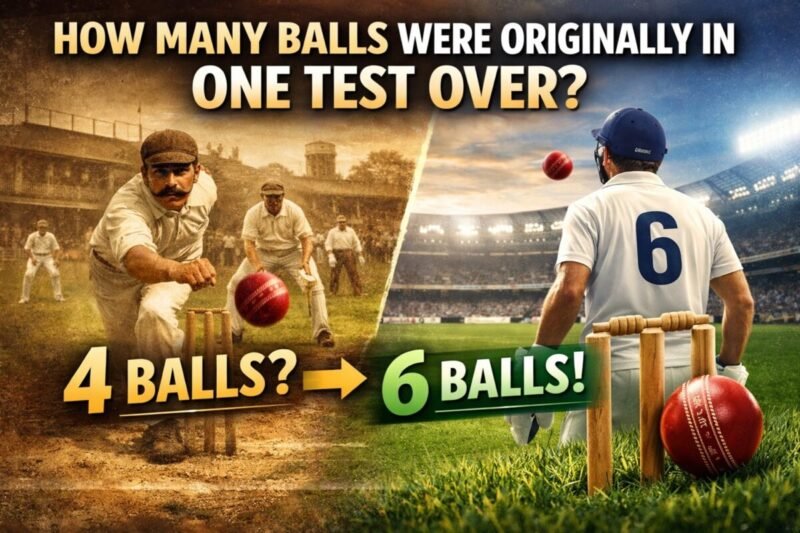
If you sit down to watch a match of cricket today, whether it’s the high-octane IPL or a classic Test match at Lord’s, one thing feels set in stone: an over consists of six balls. It is the fundamental rhythm of the game. The bowler runs in six times, the umpire calls “Over,” and the fielders swap ends. It feels like a law of nature.
But for cricket historians and trivia buffs, the number six is actually a relatively modern standardization. If you were to travel back in time to the very first Test match, you would see a different game entirely. So, how many balls were originally there in one test over?
The answer is four.
When the first-ever Test match was played between Australia and England in Melbourne in 1877, the laws of the game dictated a four-ball over. The journey from that original four-ball set to the standardized six-ball over we know today is a fascinating mix of experimentation, player fatigue, and the quest for the perfect game tempo.
The Birth of Test Cricket: The Four-Ball Era
To understand the origins, we have to look at the laws of cricket as they stood in the 19th century. In 1877, Charles Bannerman faced the first ball in Test history, and the bowlers operated in short, sharp bursts.
For the early years of Test cricket, specifically from 1877 to 1889, four balls were the global standard.
Why only four balls?
In the early days, cricket was a slower game with different bowling techniques. A four-ball over meant the game moved quickly in terms of changing ends, but it also meant batters couldn’t get “set” against a specific bowler for long.
However, this created a logistical problem. With overs changing so frequently, a significant amount of playing time was lost just by fielders walking from one end of the pitch to the other. To speed up the game and allow bowlers to build a better rhythm, administrators began to tinker with the count.
The Great Experiments: 5, 6, and 8 Ball Overs
Between 1889 and 1979, the number of balls in an over was far from consistent. It was actually up to the host nation to decide the playing conditions. This led to a confusing era where a touring team might play six-ball overs at home but have to adjust to eight-ball overs when visiting Australia.
Here is a breakdown of how the ball count fluctuated over the decades:
The Five-Ball Over
This is perhaps the weirdest footnote in cricket history. For a brief period (1889 to 1899), the standard was raised from four to five balls. It was an attempt to find a middle ground, but it didn’t stick. The rhythm felt off to both players and umpires, and it was quickly abandoned by the turn of the century.
The Eight-Ball Marathon
If four balls felt too short, eight balls often felt like a marathon. Yet, for large chunks of cricket history, the eight-ball over was the norm in the Southern Hemisphere.
- Australia used eight-ball overs from 1918 to 1978.
- South Africa used them periodically between 1938 and 1958.
- New Zealand adopted them between 1968 and 1979.
Legendary bowlers like Dennis Lillee and Jeff Thomson hurled thunderbolts in eight-ball overs. While this allowed them to work over a batsman more thoroughly, it was physically exhausting for fast bowlers, particularly in the scorching Australian heat.

The Rise of the Six-Ball Standard
While Australia favored eight, England stuck to six balls for most of the 20th century (after briefly trying five). The six-ball over offered a perfect balance. It was long enough for a bowler to execute a tactical plan, but short enough to maintain high energy levels without causing excessive fatigue.
Standardization: The ICC Steps In
In 1979, the International Cricket Council (ICC) officially standardized the six-ball over for all Test matches worldwide. To make the game global and uniform—especially with the rise of One Day International (ODI) cricket and televised World Cups—standardization was necessary.
From the 1979/1980 season onwards, the six-ball over became mandatory for all Test matches worldwide.
This decision ended nearly a century of variation. It ensured that statistics could be compared more fairly across eras and countries, although cricket statisticians still have to do complex math when comparing the strike rates of Sir Donald Bradman (who played many eight-ball overs) to modern greats like Sachin Tendulkar.
Why Six Balls is the “Goldilocks” Number
Why did six win the battle against four and eight? It comes down to the physiology of sport and the spectator experience.
- Bowler Fatigue: Bowling fast is an unnatural and violent motion for the human body. Eight balls proved to be too damaging for fast bowlers, leading to injuries and a drop in pace by the end of the over.
- Game Flow: Four balls meant too many interruptions. Just as a bowler got their line and length right, the umpire would call “Over.”
- Broadcasting: As TV became a major revenue driver, the six-ball over fit perfectly into commercial breaks and advertising slots. It provided a predictable rhythm for broadcasters.
Summary of Balls Per Over by Country
If you are preparing for a sports quiz, this simple timeline will help you remember the variations:
- England: 4 balls (until 1889), 5 balls (1889–1899), 6 balls (1900 onwards).
- Australia: 4 balls (until 1889), 6 balls (limited time), 8 balls (1918–1978), 6 balls (1979 onwards).
- South Africa: Varied between 6 and 8 balls depending on the era until standardization.
- India, West Indies, New Zealand: Generally followed the English standard of 6 balls, though New Zealand dabbled with 8 balls in the 70s.
The Legacy of the Variable Over
Knowing that the answer to “how many balls were originally there in one test over” is four changes how we view the history of the sport. It reminds us that cricket has always been an evolving game, willing to change its most fundamental laws to improve the contest between bat and ball.
The next time you watch a bowler struggling to finish an over, just remember—at least they don’t have to bowl eight deliveries like the Australian legends of the past!
Frequently Asked Questions (FAQs)
When did the 6-ball over become mandatory in Test cricket?
The six-ball over became mandatory for all Test matches starting in the 1979/1980 season. Before this, the host country determined the length of the over, which is why Australia played with eight-ball overs for many years.
Has there ever been a 10-ball over in Test cricket?
No, a legal over has never officially consisted of 10 balls as a standard rule. The maximum standard length was eight balls. However, overs can last longer than standard if the bowler bowls “extras” like wides or no-balls, which must be re-bowled.
Why did Australia stop using 8-ball overs?
Australia moved away from eight-ball overs to align with global standards set by the ICC. Additionally, the six-ball over was seen as better for bowler longevity and provided a better balance for television broadcasting.
How does the over length affect historical cricket records?
It makes comparing strike rates and economy rates difficult. A maiden over (an over with no runs scored) consisting of eight balls is more impressive than one consisting of four balls. Statisticians often have to convert these figures to “balls per wicket” or “runs per 100 balls” to make fair comparisons between players like Bradman and Kohli.
Read Also: WellHealth How to Build Muscle Tag: Your Ultimate Guide to Strength
