

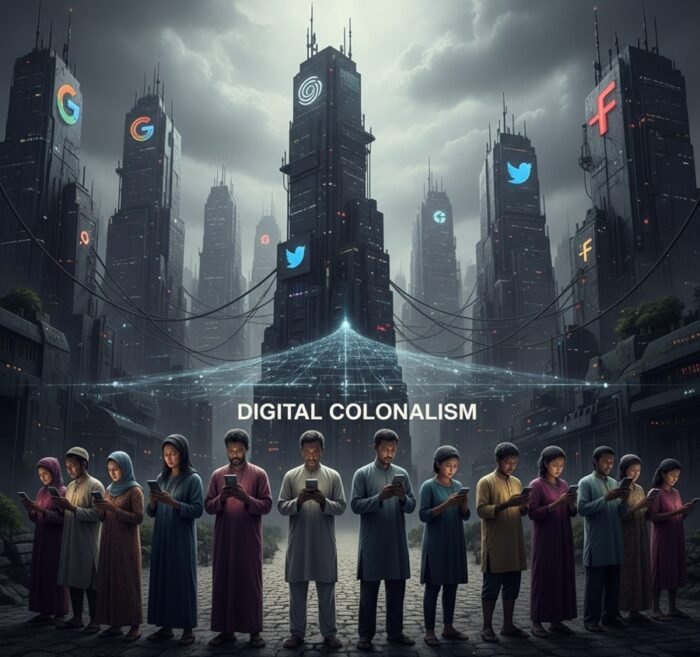
History books tell us that colonialism ended in the mid-20th century. Flags were lowered, armies retreated, and nations celebrated their hard-won independence. But look closely at the infrastructure of the modern world, and you might start to wonder if the empire truly left—or if it simply moved to the cloud.
Today, a handful of corporations based in the Global North—primarily in Silicon Valley—hold more power than many sovereign nations. They control the flow of information, the infrastructure of communication, and, most critically, the data of billions of people. This phenomenon is known as digital colonialism, and it is reshaping the geopolitical landscape in ways that are subtle, pervasive, and potentially dangerous for the developing world.
We need to ask uncomfortable questions: Are we witnessing a new era of exploitation disguised as technological progress? Are developing nations trading their resources—this time, their data—for access to the digital world?
What is Digital Colonialism?
Digital colonialism refers to a modern form of imperialism where dominant powers use digital technology to control, extract value from, and influence less powerful nations. Unlike traditional colonialism, which relied on physical occupation and the extraction of raw materials like rubber or gold, this new iteration relies on tech imperialism and the extraction of data.
It operates on a simple, uneven exchange. Big Tech companies provide free or subsidized digital services—social media platforms, search engines, cloud storage—to the Global South. In return, they gain unrestricted access to user data, market dominance, and the ability to shape the political and cultural discourse of those nations.
This creates a dependency trap. A country in the Global South might lack the resources to build its own digital infrastructure, so it relies on Google for email, Facebook for communication, and Amazon for cloud hosting. The physical servers, the proprietary algorithms, and the profits remain in the North, while the South provides the raw material: human behavior.
The Mechanics of Extraction
The engine of this system is data extraction. In the digital economy, data is often called the “new oil.” However, the refining process happens far away from the source.
When a user in Kenya, Brazil, or India uses a free platform, every click, message, and location ping is harvested. This data is fed into proprietary algorithms to train Artificial Intelligence (AI) models that are then sold back to the world as premium services. The value is generated in the developing world but captured in the West.
Surveillance Capitalism at Work
This extraction feeds into surveillance capitalism, a term popularized by scholar Shoshana Zuboff. It describes an economic system centered on the commodification of personal data. In developing nations, regulatory frameworks for privacy are often weaker or nonexistent compared to the EU’s GDPR. This allows tech giants to treat these populations as testing grounds for intrusive technologies.
For instance, we have seen loan apps in Africa that scrape phone contacts and photos to shame borrowers into repayment. We see social media algorithms that prioritize engagement over safety, inciting ethnic violence in places like Myanmar and Ethiopia, while the moderators who could stop it are underpaid and overworked in outsourced content farms.
Silicon Valley Dominance and the “Free Basics” Trap
One of the most insidious tools of digital colonialism is the “zero-rating” practice, famously exemplified by programs like Facebook’s “Free Basics.”
The pitch sounds philanthropic: bringing the internet to the unconnected poor. But the reality is often a walled garden. Users get free data, but only for a specific set of apps chosen by the provider. The internet, for many, becomes synonymous with Facebook.
This destroys net neutrality. It prevents local startups from competing because they aren’t included in the free bundle. It consolidates Silicon Valley dominance by ensuring that the next billion users are locked into specific ecosystems from their very first click. It’s the digital equivalent of a colonial railroad—built not to connect the locals to each other, but to transport resources efficiently out of the country.
The Human Cost of AI
The gleaming interfaces of AI tools like ChatGPT or Gemini hide a grim reality. Behind the “magic” of artificial intelligence lies an army of low-wage workers in the Global South.
| Feature | Traditional Colonialism | Digital Colonialism |
| Resource | Land, Gold, Rubber | Data, Behavior, Attention |
| Tool | Armies, Treaties | Algorithms, Free Apps, Cloud |
| Infrastructure | Railroads, Ports | Fiber Optics, Servers, App Stores |
| Labor | Manual/Physical | Data Labeling, Click-farming |
In Kenya, the Philippines, and Venezuela, workers sit in internet cafes or cramped offices labeling images, transcribing audio, and flagging traumatic content to clean the datasets used to train American AI. They are paid pennies for work that can be psychologically damaging.
This labor division mirrors colonial resource extraction perfectly. The Global South provides the cheap, grueling labor required to refine the raw material, while the Global North enjoys the high-value finished product and the immense profits it generates.
Global South Digital Rights and Resistance
The situation is critical, but it is not hopeless. A movement for Global South digital rights is growing. Activists, policymakers, and technologists are pushing back against the narrative that technological dependency is inevitable.
We are seeing calls for “Data Sovereignty”—the idea that data generated within a country should be subject to the laws of that country and stored within its borders. Nations like India and Rwanda are beginning to implement stricter data protection laws that challenge the hegemony of Western tech giants.
Furthermore, there is a push for “Public Digital Infrastructure.” Instead of relying on private American corporations for essential services like payments and identity verification, countries are building their own open-source alternatives. India’s Unified Payments Interface (UPI) and Brazil’s Pix are prime examples of how nations can reclaim control over their digital economies.
Reclaiming the Digital Future
Recognizing digital colonialism is the first step toward dismantling it. We must scrutinize the “gifts” of Big Tech. When a foreign corporation offers free infrastructure, we must ask: What is the hidden cost?
For the developing world, the path forward involves investing in local innovation, enforcing strong privacy regulations, and treating data as a sovereign national resource. For the global community, it means demanding that technology serves humanity equally, rather than widening the chasm between the powerful and the powerless.
The empires of the past were built on land and sea. The empires of today are built on code and servers. It is time to decolonize the internet.
Read Also: The Era of Decentralized Media Communities Is Here
