

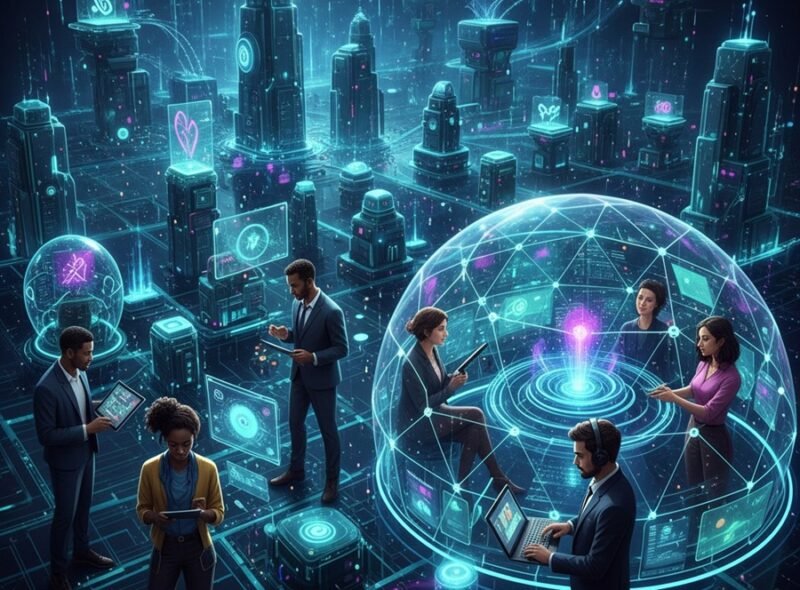
The digital town square is getting too loud, too crowded, and increasingly hostile. For over a decade, the internet’s power brokers—Facebook, Twitter (now X), and Instagram—relied on a centralized model where algorithms dictated culture. They promised connection but delivered distraction. Now, a massive migration is underway. Users are leaving the open, chaotic feeds of legacy platforms for smaller, gated, and highly specific groups.
We are witnessing the rise of decentralized media communities. This isn’t just a change in user behavior; it is a fundamental restructuring of how we consume information, build trust, and transact online. For venture capitalists, creators, and media strategists, understanding this shift is no longer optional. It is the only way to survive the fragmentation of the internet.
The Decline of Mass Media and the Algorithmic Fatigue
The broadcast model of the 20th century, which transitioned into the algorithmic feed of the 2010s, relied on scale. The goal was to reach the maximum number of eyeballs with the broadest possible message. But the decline of mass media isn’t happening because people stopped consuming content. It’s happening because the trust in broad, faceless distribution channels has evaporated.
Algorithmic fatigue has set in. Users are tired of fighting for attention in an arena where the rules change weekly. Creators are exhausted by the “rented land” problem—building massive audiences on platforms that can throttle their reach with a single code update.
The response to this fatigue is a retreat into private digital spaces. These are environments where context is high, noise is low, and the algorithm is replaced by human curation. We are moving from a “feed-first” internet to a “community-first” internet. In this new paradigm, value is not measured by likes or impressions, but by the depth of engagement and the density of trust within the network.
The Mechanics of Creator-Led Economies
Creators who moved even a small percentage of their audience into private communities often report higher revenue stability despite lower reach.
This shift redefines the economic model of the web. The centralized web ran on advertising; the decentralized web runs on direct value exchange. Creator-led economies are emerging as the dominant financial structure within these new communities.
| Feature | Legacy Social Media (Old) | Decentralized Communities (New) |
| Primary Metric | Reach / Impressions | Trust / Engagement Density |
| Monetization | Advertising (Indirect) | Subscriptions / Value Exchange (Direct) |
| Ownership | Platform owns the data | Creator/Community owns the list |
| Algorithm | AI-driven discovery | Human curation & Opt-in |
In a centralized model, the platform extracts value from the user data and sells it to advertisers. The creator gets a fraction of the revenue (if they are lucky). In decentralized media communities, the economic relationship is direct. A creator offers specific insight, access, or utility, and the community member pays for it directly via subscriptions, memberships, or digital assets.
This aligns incentives. The creator no longer needs to rage-bait an algorithm to go viral; they only need to serve the specific needs of their niche. It turns media from a volume business into a loyalty business. A community of 1,000 true fans paying a monthly subscription is a sustainable business; a following of 100,000 passive scrollers on TikTok is a fragile vanity metric.
The Future of Substack and Discord
The infrastructure powering this migration is maturing rapidly. To understand where this is going, we have to look at the future of Substack and Discord. These platforms represent two sides of the decentralized coin: publishing and conversation.
Substack started as a tool for newsletters, but it has evolved into a decentralized media network. It allows writers to own their email lists—the ultimate portable asset—while providing a network effect that helps them grow. It is a rebellion against the ad-model, proving that people are willing to pay for high-quality, niche writing.
Discord, conversely, represents the shift in conversation. It is the anti-feed. It organizes people into servers based on shared interests, from Web3 gaming to knitting circles. The architecture of Discord forces users to opt-in. You don’t stumble across content; you enter a room.
The future lies in the convergence of these tools. We will see platforms that blend the editorial depth of a newsletter with the real-time vibrancy of a chat server. The successful media companies of the next decade will look less like The New York Times and more like a bundle of high-value Discords and Substacks, loosely aggregated under a shared mission.
Mastering Niche Community Marketing
For brands and marketers, this fragmentation presents a terrifying challenge. You can no longer buy a homepage takeover and reach everyone. Niche community marketing requires a scalpel, not a sledgehammer.
Marketing in decentralized spaces cannot be interruptive. You cannot force a banner ad into a private Discord server without facing immediate backlash. Instead, marketing must become participatory. Brands have to act like members of the community rather than landlords.
This requires a strategy of “value-first” contribution. It means sponsoring the tools the community uses, co-creating content with community leaders, or providing exclusive access that reinforces the community’s identity. The goal is not to extract attention, but to facilitate connection. If a brand can help the community achieve its goals, it earns the right to be there. If it’s just there to extract data, it will be rejected.
Building the Moat
The only defensible moat in the modern media landscape is community. Code can be copied. Content can be commoditized. But a vibrant, self-regulating culture of people who trust one another cannot be easily replicated.
Decentralized media communities are resilient. Because they are distributed and owned (psychologically and often financially) by their members, they survive platform shifts. If a specific tool dies, the community migrates to the next one.
For the builders and investors reading this: stop looking for the next platform that reaches a billion people. Look for the tools that help one thousand people talk to each other more effectively. The mass market is over. The era of the tribe has begun.
Read Also: The AI Authenticity Paradox: Why We Crave Real Connections in a Synthetic World
