

By Satendra Kumar, Founder — PrimeScroll
Let me be honest with you upfront. When my neighbor asked me last month which electric car he should buy under ₹15 lakh, my first instinct was to say, “Wait a year.” But when I actually sat down and looked at what’s available in 2026, I changed my mind completely.
The budget EV segment has genuinely matured. You’re no longer compromising. You’re choosing.
Here’s everything you need to know — prices, real-world range, honest pros and cons — to make the right call for your family.
Why 2026 Is Actually a Good Year to Buy a Budget EV
Fuel prices in metro cities are sitting above ₹100/litre with no sign of dropping. Meanwhile, EV running costs have stayed remarkably stable — roughly ₹1 to ₹1.5 per kilometre when charging at home, compared to ₹5–6 per kilometre for a petrol car. For a family driving 1,200 km a month, that’s a saving of close to ₹60,000 per year. Over five years, that math gets very interesting.
Add government subsidies under FAME-II, lower road tax in most states, and reduced service costs (no engine oil, no clutch, no gearbox), and the total cost of ownership picture looks very different from the sticker price.
The 4 Best Electric Cars Under ₹15 Lakh Right Now
1. Tata Punch EV Facelift 2026 — Best Overall Pick
Ex-showroom price: ₹9.69 lakh – ₹12.59 lakh Battery options: 30 kWh / 40 kWh ARAI claimed range: 375 km / 468 km Real-world range: ~220 km (30 kWh) / ~300–320 km (40 kWh) in mixed driving
The Punch EV facelift launched in February 2026 and it has been flying off dealership shelves ever since — waiting periods have stretched to 10 weeks in many cities. That kind of demand is usually a reliable signal.
Built on Tata’s dedicated Acti.ev platform, the Punch EV is not a converted petrol car. The 40 kWh long-range variant now uses LFP prismatic cells that are 10% more energy-dense than before and support DC fast charging at 65 kW — meaning 20–80% in just 26 minutes. A quick 15-minute top-up adds roughly 135 km of range. That’s enough for most Indian city daily commutes.
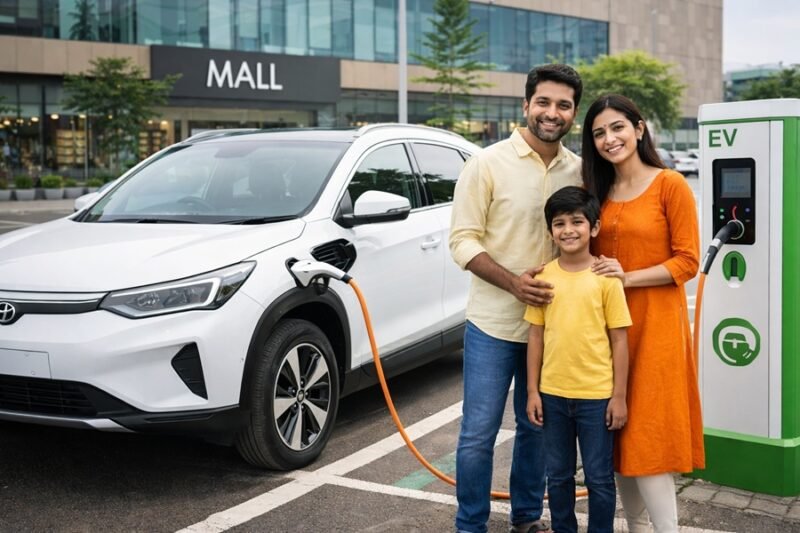
The cabin gets a 10.25-inch touchscreen, dual digital displays, ventilated front seats, wireless charging, and a 360-degree camera on higher variants. Ground clearance is 195 mm with a water wading depth of 450 mm — both solid numbers for Indian monsoon conditions. The Punch EV also carries a 5-star Bharat NCAP rating.
For the 40 kWh variant, Tata is offering a lifetime battery warranty (15 years for the first owner), which should address long-term concerns about battery health.
Honest Pros:
- Best safety rating in segment (5-star BNCAP)
- Compact size ideal for city driving
- Fastest DC charging in its class
- V2L support lets you power appliances from the car
Honest Cons:
- Rear seat is tight for three adults
- Top variants push close to Nexon EV pricing
- 30 kWh variant’s real-world range may feel limiting on highway trips
Verdict: If you drive mostly within the city and want a reliable, safe, well-equipped EV under ₹13 lakh, the Punch EV is the strongest recommendation I can make right now.
2. Tata Nexon EV 2026 — Best for Families Who Need Space and Range
Ex-showroom price: ₹12.49 lakh – ₹17.49 lakh (variants under ₹15L available) Battery: 45 kWh ARAI claimed range: 489 km Real-world range: ~350 km (city + highway mixed, per Autocar India tests)
The Nexon EV has been India’s best-selling electric car for a reason — it’s dependable. The 45 kWh battery variant is what you should look at if you’re planning highway trips or live in a Tier-2 city where charging infrastructure may be less dense.
In real-world testing, the Nexon EV 45 delivered 355 km in city conditions and 345 km on the highway — one of the most consistent range figures in its class. Charging from 20–80% takes under 30 minutes on a DC fast charger.
The cabin is noticeably roomier than the Punch EV. Five adults can travel comfortably. Boot space is practical for family luggage.
Honest Pros:
- Best real-world range under ₹15 lakh
- Proven reliability track record
- More spacious cabin than Punch EV
- Strong Tata service network across India
Honest Cons:
- Entry variants under ₹15 lakh get fewer features
- Some users online report inconsistent range in extreme summer heat
- Design hasn’t changed significantly — may feel dated compared to newer rivals
Verdict: If your family does a mix of city driving and occasional highway trips — Delhi to Agra, Pune to Mumbai — the Nexon EV 45 is worth stretching the budget slightly for the peace of mind.
3. MG Windsor EV — Best Feature-to-Price Ratio
Ex-showroom price: ₹14 lakh (standard) / higher for Pro variant Battery: 38 kWh (standard) / 52.9 kWh (Windsor Pro) ARAI claimed range: 332 km – 449 km Real-world range: ~308 km combined (city: 327 km, highway: 289 km per Autocar India)
The Windsor EV is a genuinely impressive product. For ₹14 lakh, you get a 15.6-inch touchscreen, multi-colour ambient lighting, reclining rear seats, and a cabin that feels premium well above its price point.
Battery efficiency is exceptional — the 38 kWh pack managed 8.1 km/kWh in real-world tests, better than the Nexon EV’s 7.79 km/kWh. A 35-minute DC fast charge adds roughly 232 km of range.
MG also offers a Battery-as-a-Service (BaaS) model where you pay a lower upfront cost and lease the battery monthly — useful if you’re budget-constrained at purchase but comfortable with EMIs.
Honest Pros:
- Most premium interior under ₹15 lakh
- Excellent battery efficiency
- Large 15.6-inch touchscreen, reclining rear seats
- BaaS model reduces upfront cost significantly
Honest Cons:
- No physical controls for key functions — takes adjustment
- MG service network not as widespread as Tata’s in smaller cities
- Polarising design — some love it, some don’t
- 38 kWh is smaller than Nexon EV’s 45 kWh
Verdict: If you’re based in a metro or large city with good MG service access and you prioritise a premium in-car experience over everything else, the Windsor EV delivers remarkable value.
4. Mahindra XUV 3XO EV — The New Challenger Worth Watching
Ex-showroom price: ₹13.89 lakh – ₹14.96 lakh Battery: 39.4 kWh ARAI claimed range: 456 km
Launched in February 2026, the XUV 3XO EV is the newest entrant in this segment and competes directly with the Nexon EV and Windsor EV. With 456 km of claimed range from a 39.4 kWh battery, the efficiency numbers look strong on paper.
It’s too early to have extensive real-world range data from independent tests. If you’re considering this, wait for 3–4 months of owner reviews before committing.
Honest Pros:
- Strong claimed range for battery size
- Mahindra brand reliability
- Competitive pricing
Honest Cons:
- Limited real-world ownership data available yet
- Mahindra EV service infrastructure still developing nationally
The 5 Questions Every Indian EV Buyer Must Answer First
1. Do you have home charging? This is the single most important factor. If you live in an apartment without charging access, owning an EV becomes a logistical challenge. Public charging infrastructure is improving but not yet at the level where you can depend on it daily.
2. What is your daily driving distance? Under 40 km per day — any car in this list covers you comfortably. 80–100 km daily — stick to the Nexon EV 45 or Windsor EV for comfortable margins. Above 120 km daily in the city — reconsider or ensure workplace charging is available.
3. How do EVs perform in the Indian monsoon? Both the Punch EV and Nexon EV carry IP67-rated battery and motor protection, which means they’re sealed against water ingress. Ground clearance on the Punch EV (195 mm) and Nexon EV is adequate for waterlogged roads typical of Indian cities. EVs are generally safe to drive in rain — just avoid submerging the car beyond the manufacturer’s water wading depth.
4. What about resale value? The honest answer: EV resale values in India are still lower than equivalent petrol cars, but the gap is narrowing each year as used EV demand grows. Tata’s brand has the strongest resale performance in the EV segment currently, largely because of its service network and brand trust.
5. What is the real maintenance cost? EVs have significantly fewer moving parts. No engine oil changes, no timing belt, no clutch replacement. Most EV service bills in India today are routine checks, tyre rotations, brake fluid top-ups, and software updates. Expect to spend 30–50% less on maintenance annually compared to a petrol car in the same price range.
Quick Comparison: Which One Should You Buy?
| Tata Punch EV | Tata Nexon EV | MG Windsor EV | Mahindra XUV 3XO EV | |
|---|---|---|---|---|
| Starting Price | ₹9.69L | ₹12.49L | ₹14L | ₹13.89L |
| Real-World Range | ~300–320 km | ~350 km | ~308 km | TBD |
| Best For | City driving | Highway + city | Premium features | Wait for data |
| Service Network | Excellent | Excellent | Good (metros) | Developing |
| Safety Rating | 5-star BNCAP | Strong | Not tested | Not tested |
My Honest Recommendation
If you’re buying your first EV and mostly drive within a city — Tata Punch EV 40 kWh. The safety rating, home charging compatibility, compact size, and Tata’s service network make it the lowest-risk entry into EV ownership.
If you need more range and cabin space for a family — Tata Nexon EV 45. Pay the extra ₹1–2 lakh over the entry variant. You’ll sleep better on highway trips.
If you want the most premium experience and live in a metro — MG Windsor EV. The interior quality at ₹14 lakh is hard to match.
The Indian EV market has reached a point where you’re not buying a compromise. You’re buying a genuinely capable car that happens to cost ₹1 per km to run.
Satendra Kumar is the founder of PrimeScroll, covering automotive and technology trends in India. Have a question about buying your first EV? Drop it in the comments.
