


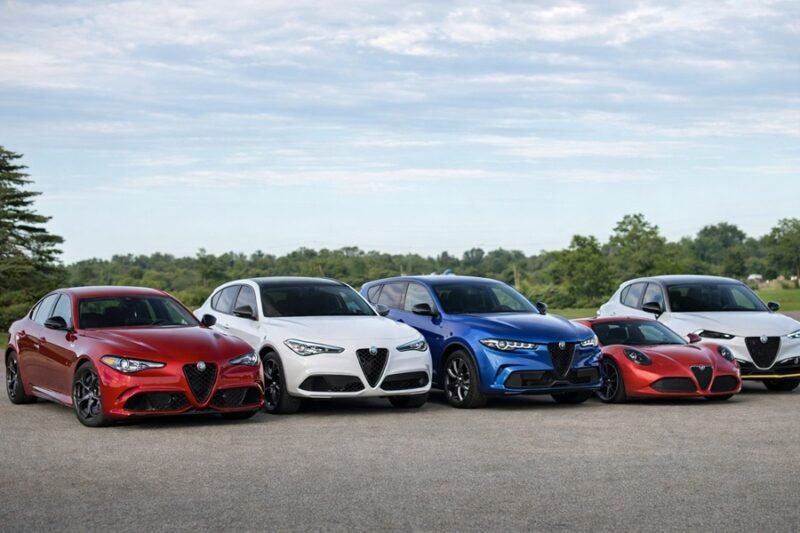
While enthusiasts have waited for decades, 2026 marks the year of the Italian renaissance. If you are curious about the Alfa Romeo car price in India 2026, our guide covers everything from the Junior to the high-performance 4C.
Alfa Romeo car price in India 2026 is expected to start from ₹40 lakh for the Junior and may go up to ₹1.5 crore for the limited 4C. The Giulia, Tonale, and Stelvio are likely to be priced between ₹45 lakh and ₹75 lakh depending on import strategy and duties.
| Model | Expected Price | Launch Year |
| Junior | ₹40–45 Lakh | 2026 |
| Giulia | ₹45–55 Lakh | 2026 |
| Tonale | ₹50–60 Lakh | 2026 |
| Stelvio | ₹60–75 Lakh | 2026 |
| 4C | ₹1–1.5 Crore | Limited |
Alfa Romeo is expected to launch five models in India by 2026, including the Giulia sports sedan, Stelvio SUV, Tonale hybrid, 4C limited edition, and Junior compact SUV. These Italian performance vehicles will compete in the premium segment with pricing likely between ₹40 lakh and ₹1.5 crore, targeting enthusiasts seeking alternatives to German luxury brands.
For decades, Indian automotive enthusiasts have watched Alfa Romeo from a distance—admiring the brand’s racing heritage, distinctive design language, and commitment to “Cuore Sportivo” (Sporting Heart). While European and American markets enjoyed these Italian masterpieces, Indian roads remained largely untouched by the serpent emblem.
That’s about to change. Industry insiders suggest 2026 could mark Alfa Romeo’s official entry into India, bringing a carefully curated lineup of performance-focused vehicles. This strategic move comes as Indian luxury car buyers increasingly seek alternatives beyond the established German Big Three—BMW, Mercedes-Benz, and Audi.
The timing aligns with India’s growing appetite for niche luxury brands. Brands like Maserati, Lamborghini, and Ferrari have already proven that Indian buyers are willing to pay premium prices for emotional, driver-focused vehicles. Alfa Romeo’s unique blend of Italian design, motorsport DNA, and accessible luxury positioning could fill a gap in the market.
Stellantis, Alfa Romeo’s parent company, has been expanding its India operations through Jeep and Citroën. This established infrastructure provides the foundation for Alfa Romeo’s market entry, from service networks to import logistics. The question isn’t whether Alfa Romeo will come to India—it’s which models will lead the charge.
Alfa Romeo Giulia: The Driver’s Sports Sedan
The Giulia represents everything Alfa Romeo stands for: dramatic styling, engaging dynamics, and an uncompromising focus on driving pleasure. Unlike German competitors that prioritize refinement and technology, the Giulia appeals to those who value steering feel and chassis balance above all else.
Performance and Engineering Excellence
At the heart of the standard Giulia sits a 2.0-liter turbocharged four-cylinder engine producing approximately 280 horsepower. Power flows through an eight-speed automatic transmission to the rear wheels—a refreshingly traditional layout in an era of all-wheel-drive sedans.
The steering system deserves special mention. Alfa Romeo engineered the Giulia with the quickest steering rack in its class, providing immediate response to driver inputs. This creates a direct connection between driver and road that’s becoming increasingly rare in modern vehicles.
The chassis uses a near-perfect 50/50 weight distribution, achieved through strategic placement of the engine, transmission, and fuel tank. Aluminum and carbon fiber construction keeps weight down while maintaining structural rigidity. These engineering choices prioritize handling dynamics over maximum cargo capacity or rear-seat space.
Design Language and Brand Identity
The Giulia’s design revolves around the iconic “V-Scudetto” grille—a triangular element that’s defined Alfa Romeo vehicles since the 1950s. The teardrop profile creates visual tension, with muscular rear haunches suggesting the car’s rear-drive layout.
Inside, the cabin blends Italian craftsmanship with driver-focused ergonomics. Controls are angled toward the driver, reinforcing the car’s sporting intent. Material quality matches premium German competitors, with options for carbon fiber trim and hand-stitched leather.
Market Positioning in India
The Giulia will directly challenge the BMW 3 Series and Audi A4 in the premium sports sedan segment. Expected pricing between ₹45-55 lakh (depending on import strategy) positions it competitively against established rivals.
The key differentiation lies in character rather than specification sheets. Where German sedans emphasize technology and prestige, the Giulia offers raw driving emotion—a proposition that resonates with a specific subset of luxury buyers.
Alfa Romeo Stelvio: High Performance Meets SUV Practicality
The Stelvio takes its name from the legendary Stelvio Pass in the Italian Alps—a road featuring 48 hairpin turns and sweeping mountain vistas. This naming choice signals Alfa Romeo’s intention: creating an SUV that drives like a sports car.
Engineering the Impossible Balance
Most SUVs sacrifice handling for practicality. The Stelvio refuses this compromise. Alfa Romeo’s engineers achieved a 50/50 weight distribution despite the vehicle’s raised ride height and larger dimensions.
The Q4 all-wheel-drive system operates primarily in rear-wheel-drive mode, sending power to the front axle only when sensors detect slip. This maintains the engaging character of rear-drive vehicles while providing all-weather capability—crucial for Indian buyers facing monsoon conditions.
Ground clearance measures approximately 190mm, sufficient for navigating poorly maintained urban roads and occasional rural excursions. The suspension uses adaptive dampers that adjust based on driving mode, balancing comfort and control.
Interior Craftsmanship and Technology
Step inside the Stelvio and you’ll find an environment that prioritizes quality over quantity. Real wood or carbon fiber inserts accent premium leather surfaces. The dashboard layout remains uncluttered, with physical controls for essential functions.
Owners looking for DIY maintenance or specific part replacements can refer to our guide on Alfa Romeo Stelvio plastic rivets for bodywork repairs.
The infotainment system integrates Apple CarPlay and Android Auto, though some critics note it lacks the sophistication of German competitors’ interfaces. Alfa Romeo’s philosophy suggests this reflects intentional simplicity rather than technical limitation.
Rear-seat space accommodates adults comfortably, though it’s not class-leading. The cargo area provides adequate storage for weekly shopping or weekend getaways, expandable by folding the rear seats.
Competitive Landscape
In India, the Stelvio will compete against the BMW X3, Audi Q5, and Mercedes-Benz GLC. Expected pricing around ₹60-75 lakh positions it as a premium alternative within this segment.
The value proposition centers on driving dynamics. While competitors offer more rear-seat space or advanced driver assistance systems, the Stelvio delivers unmatched handling prowess for an SUV. Buyers who prioritize the driver’s experience over maximum practicality will find this trade-off appealing.
Alfa Romeo Tonale: Bridging Tradition and Electrification
The Tonale marks Alfa Romeo’s first serious commitment to electrification. According to the Stellantis Dare Forward 2030 strategic plan, the brand is rapidly transitioning toward a sustainable future while maintaining its performance DNA.
This compact SUV blends the brand’s sporting heritage with modern hybrid technology, targeting environmentally conscious buyers who refuse to sacrifice performance.
Plug-in Hybrid Technology
The Tonale’s plug-in hybrid system combines a 1.3-liter turbocharged gasoline engine with an electric motor, producing a combined output exceeding 275 horsepower. The battery pack enables approximately 60 kilometers of pure electric driving—sufficient for most daily commutes.
This dual-power approach addresses India’s inconsistent charging infrastructure. Owners can drive emission-free in the city while relying on gasoline power for highway journeys or areas lacking charging stations.
The regenerative braking system recovers energy during deceleration, extending electric range. Multiple driving modes allow owners to prioritize electric operation, maximize performance, or balance both objectives.
Blockchain Innovation
Alfa Romeo introduced a groundbreaking feature with the Tonale: blockchain-based vehicle certification. The system creates a tamper-proof digital record of the vehicle’s maintenance history, mileage, and other critical data.
Each Tonale receives a unique NFT (non-fungible token) that accompanies the vehicle throughout its lifecycle. This technology could revolutionize the Indian used car market, where odometer fraud and questionable service histories plague buyers.
While some dismiss this as a marketing gimmick, the underlying technology addresses real pain points in vehicle ownership and resale. If successful, expect other manufacturers to adopt similar systems.
Urban Versatility
The Tonale’s compact dimensions suit congested Indian cities. At approximately 4.5 meters long, it navigates narrow streets and tight parking spaces more easily than larger SUVs.
Despite its modest footprint, the interior provides adequate space for four adults. The rear seats accommodate two passengers comfortably, with acceptable headroom and legroom. Cargo capacity serves everyday needs without matching larger competitors.
Build quality reflects Alfa Romeo’s commitment to premium materials. Soft-touch surfaces, ambient lighting, and attention to detail create an upscale environment that punches above the Tonale’s size class.
Market Strategy
Expected pricing between ₹50-60 lakh positions the Tonale against the BMW X1, Audi Q3, and Volvo XC40 Recharge. The plug-in hybrid configuration could qualify for certain government incentives, potentially reducing the effective purchase price.
The Tonale appeals to buyers seeking Italian style and performance without the larger footprint or higher pricing of the Stelvio. It’s an entry point into Alfa Romeo ownership that doesn’t feel like a compromise.
Alfa Romeo 4C: The Collector’s Dream
The 4C occupies a unique position in Alfa Romeo’s lineup—a focused, uncompromising sports car that prioritizes driving purity over comfort or convenience. If it reaches India, expect extremely limited numbers through CBU (Completely Built Unit) imports.
Carbon Fiber Construction
The 4C’s defining feature is its carbon fiber monocoque chassis. This racing-derived construction method creates exceptional rigidity while keeping weight below 1,000 kilograms—less than many compact hatchbacks.
The mid-engine layout places a turbocharged 1.75-liter four-cylinder directly behind the driver. This compact powerplant produces approximately 240 horsepower—modest by modern standards, but devastating when combined with the car’s featherweight construction.
Weight distribution favors the rear wheels, enhancing traction during acceleration and rotation through corners. The suspension uses competition-inspired double wishbones at all four corners, providing precise wheel control.
The No-Compromise Philosophy
The 4C lacks power steering. This controversial decision eliminates weight and complexity while providing unfiltered feedback from the front wheels. Steering effort increases at low speeds but delivers unmatched precision once moving.
Similarly, the car omits creature comforts like advanced infotainment systems or adaptive cruise control. The cabin focuses entirely on driving essentials: a steering wheel, pedals, shifter, and instruments.
This purity appeals to a specific buyer—someone who views driving as an art form rather than mere transportation. The 4C demands skill and attention, rewarding drivers who invest time mastering its character.
Limited Availability Strategy
If Alfa Romeo imports the 4C to India, expect allocation limited to perhaps 10-20 units annually. Pricing could reach ₹1-1.5 crore, positioning it as an exclusive collector’s item rather than a volume model.
The business case isn’t direct profitability. Instead, the 4C serves as a halo product—generating brand excitement and demonstrating Alfa Romeo’s engineering capabilities. Its presence elevates the entire lineup, even if few buyers can afford or appreciate such an uncompromising machine.
Alfa Romeo Junior: The Accessible Gateway
The Junior represents Alfa Romeo’s most important model for the Indian market. As the entry point into the brand, it must balance accessibility with the performance and style expectations associated with the serpent emblem.
Dual Powertrain Strategy
Alfa Romeo plans to offer the Junior in two configurations: Elettrica (full electric) and Ibrida (mild hybrid). This dual approach addresses diverse buyer preferences and varying infrastructure readiness across India.
The Elettrica variant uses a battery-electric powertrain producing approximately 156 horsepower. Range estimates suggest 350-400 kilometers on a full charge—adequate for urban use but requiring planning for longer journeys.
The Ibrida version combines a turbocharged gasoline engine with a 48-volt mild hybrid system. This configuration delivers responsive performance while maintaining fuel efficiency, without requiring dedicated charging infrastructure.
Design for a New Generation
The Junior’s styling targets younger luxury buyers. The “Progresso” grille reinterprets Alfa Romeo’s traditional V-Scudetto in a more contemporary form. LED headlamps feature a distinctive “3+3” pattern that creates an unmistakable lighting signature.
The compact SUV silhouette follows current market trends while incorporating Italian design flair. Character lines flow from front to rear, creating visual movement even when stationary. Color options include bold, youth-oriented hues alongside traditional metallics.
Inside, technology takes center stage. A large touchscreen dominates the dashboard, integrating infotainment, navigation, and vehicle settings. Digital instruments provide customizable displays, adapting to different driving modes.
Competitive Pricing and Positioning
The Junior’s success depends on aggressive pricing. Expected to start around ₹40-45 lakh, it must undercut the Stelvio while maintaining sufficient margin above mainstream premium brands.
Competitors include the Mercedes-Benz GLA, BMW X1, and Audi Q3. However, the Junior’s Italian character and distinctive design could attract buyers seeking alternatives to the German establishment.
The electric variant appeals to environmentally conscious buyers in metro cities with developing charging infrastructure. The hybrid version serves those in tier-2 cities or buyers concerned about range anxiety.
| Model | Body Style | Expected Price | Primary Rival |
| Junior | Compact SUV | ₹40–45 Lakh | BMW X1, Audi Q3 |
| Giulia | Sports Sedan | ₹45–55 Lakh | BMW 3 Series, Audi A4 |
| Tonale | Plug-in Hybrid SUV | ₹50–60 Lakh | Volvo XC40 Recharge |
| Stelvio | Performance SUV | ₹60–75 Lakh | BMW X3, Mercedes-Benz GLC |
| 4C | Limited Sports Car | ₹1–1.5 Crore | Exclusive Collectors |
For a detailed breakdown of variants, taxes, and updated Alfa Romeo car price in India 2026, read our complete pricing guide.
Market Entry Strategy and Challenges
Launching Alfa Romeo in India presents significant challenges beyond simply shipping vehicles. Success requires careful planning across pricing, service, and brand perception.
Import Strategy and Pricing
Stellantis faces a critical decision: import vehicles as CBUs or establish local CKD (Completely Knocked Down) assembly. CBU imports simplify initial market entry but result in higher prices due to import duties—currently around 60-100% depending on vehicle specifications.
India currently imposes up to 100% customs duty on fully imported luxury vehicles, significantly impacting final on-road pricing.
Based on current import duty structure in India (60–100%), initial Alfa Romeo models will likely arrive as CBUs before any local CKD assembly is considered.
CKD assembly reduces costs by avoiding some import duties, but requires minimum volume commitments and infrastructure investment. Given India’s uncertain demand for Alfa Romeo vehicles, CBU imports seem more likely initially, with potential CKD assembly if sales justify the investment.
This strategy suggests premium pricing. The Giulia could start around ₹45-50 lakh, the Stelvio at ₹60-70 lakh, and the Tonale at ₹50-55 lakh. The Junior, if positioned as the volume leader, might start near ₹40-45 lakh. The 4C, as a limited collector’s item, could command ₹1-1.5 crore.
Service Network Development
Luxury car buyers demand premium service experiences. Alfa Romeo can leverage Stellantis’s existing Jeep and Citroën infrastructure, but these mass-market facilities may not meet luxury expectations.
The solution likely involves dedicated Alfa Romeo service centers in major metros—Mumbai, Delhi, Bangalore, Chennai, Hyderabad, and Pune. These facilities would feature Italian-trained technicians, specialized diagnostic equipment, and premium customer lounges.
While Stellantis plans new facilities, you can find the current list of authorized Alfa Romeo showroom in India locations here.
Smaller cities might receive service through authorized partners within existing Stellantis dealers, creating a tiered service network. This approach balances coverage with investment requirements.
Parts availability represents another challenge. Alfa Romeo must establish efficient import channels for genuine components while managing inventory to avoid long wait times. The alternative—extensive local parts stocking—ties up significant capital.
Building Brand Perception
Alfa Romeo faces a perception challenge in India. Unlike Ferrari or Lamborghini, which benefit from supercar prestige, Alfa Romeo remains relatively unknown outside enthusiast circles.
The marketing strategy must educate buyers about the brand’s racing heritage, design philosophy, and engineering excellence. Storytelling around the “Cuore Sportivo” philosophy can differentiate Alfa Romeo from competitors focused on technology or luxury.
Strategic partnerships with automotive media, influencer collaborations, and experiential driving events can build awareness. Allowing potential buyers to experience vehicles firsthand—particularly the Giulia’s steering precision or the Stelvio’s handling—creates emotional connections that specifications cannot match.
Addressing reliability concerns proves equally important. Alfa Romeo has historically struggled with quality perceptions, particularly in markets accustomed to German precision. Stellantis must emphasize improvements in manufacturing quality and offer comprehensive warranty coverage to overcome this legacy.
Frequently Asked Questions
When will Alfa Romeo officially launch in India?
While no official confirmation exists, industry sources suggest 2026 as the likely timeframe. This aligns with Stellantis’s expansion plans for premium brands in the Indian market.
Will Alfa Romeo vehicles be affordable compared to German competitors?
Pricing will depend on import strategy. If imported as CBUs, expect prices comparable to or slightly higher than equivalent BMW, Audi, and Mercedes-Benz models. Local assembly could enable more competitive pricing in the future.
Where will Alfa Romeo service centers be located?
Initial service centers will likely concentrate in major metros: Mumbai, Delhi, Bangalore, Chennai, Hyderabad, and Pune. Expansion to tier-2 cities would follow if initial sales meet expectations.
Are Alfa Romeo vehicles reliable?
Modern Alfa Romeo vehicles have significantly improved in reliability compared to older models. However, they may require more specialized maintenance than German competitors. Comprehensive warranty coverage should address buyer concerns.
Which Alfa Romeo model is best for Indian roads?
The Stelvio offers the best balance of performance and practicality for Indian conditions. Its high ground clearance, all-wheel drive, and SUV versatility suit varied road conditions while maintaining Alfa Romeo’s sporting character. The Junior provides a more affordable entry point with adequate ground clearance for urban driving.
The Italian Automotive Renaissance Begins
Alfa Romeo’s potential 2026 India launch represents more than adding another luxury brand to the market. It signals the arrival of an alternative philosophy—one that prioritizes driving emotion over specification sheets, Italian artistry over German precision, and character over clinical perfection.
The five-model strategy covers diverse buyer preferences. The Giulia satisfies driving purists seeking sedan dynamics. The Stelvio delivers SUV practicality without sacrificing performance. The Tonale embraces electrification while maintaining sporting credentials. The 4C appeals to collectors seeking automotive art. The Junior provides accessible entry into the Alfa Romeo lifestyle.
Success isn’t guaranteed. Alfa Romeo must overcome limited brand awareness, establish robust service infrastructure, and justify premium pricing in a competitive market. Yet the opportunity exists for buyers tired of German homogeneity, seeking Italian passion on Indian roads.
For enthusiasts who’ve admired Alfa Romeo from afar, 2026 could finally deliver the opportunity to experience the serpent emblem firsthand. The question isn’t whether these vehicles can succeed in India—it’s whether India is ready for Alfa Romeo.
Which of these Italian masterpieces would earn a place in your garage? Share your thoughts in the comments below, and spread the word to fellow automotive enthusiasts who’ve been waiting for this Italian renaissance.
For real-time updates on Alfa Romeo launch date in India, follow Prime Scroll and bookmark this page.
