


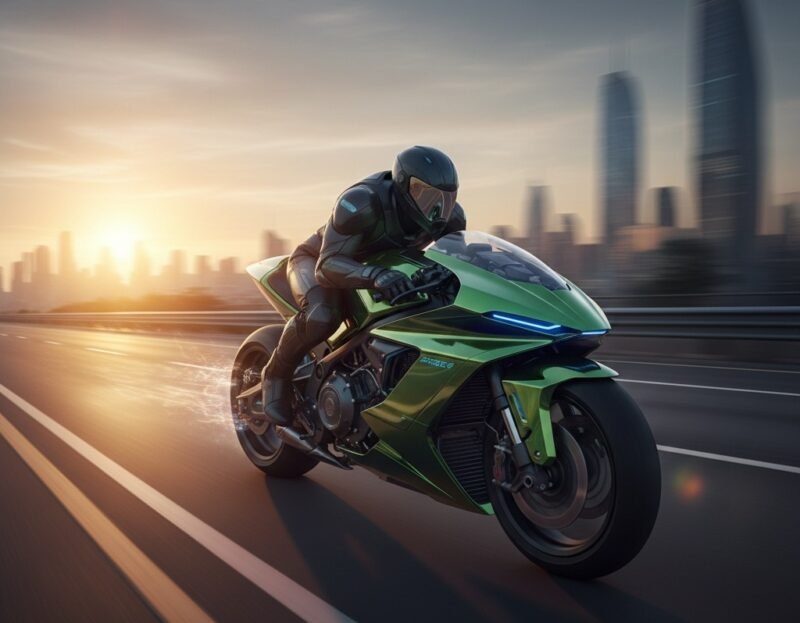
There’s a moment—right before the throttle opens fully—where everything goes quiet. Then the world blurs. That’s what separates a fast motorcycle from the fastest motorcycle. And if you’ve ever found yourself deep in a forum debate at 2 a.m. arguing horsepower figures and trap speeds, you already know this rabbit hole goes deep.
So, which is the fastest bike in the world right now? The short answer: the Kawasaki Ninja H2R holds the crown for the fastest production-based motorcycle, clocking speeds beyond 400 km/h (249 mph). But the full answer is far more interesting—and far more contested.
This guide breaks down the top contenders, their specs, what actually makes a bike “the fastest,” and why the rivalry between manufacturers like Kawasaki, Ducati, and Lightning Motorcycles is reshaping what we thought was possible on two wheels.
Key Takeaways
| Bike | Top Speed | Engine | Type |
| Kawasaki Ninja H2R | 400+ km/h (249+ mph) | 998cc supercharged inline-4 | Track only |
| Kawasaki Ninja H2 | 249 km/h (155 mph) | 998cc supercharged inline-4 | Gentleman’s Agreement. |
| Ducati Panigale V4 R | 299 km/h (186 mph) | 998cc V4 | Street legal |
| Suzuki Hayabusa | 299 km/h (186 mph) | 1340cc inline-4 | Street legal |
| Lightning LS-218 | 350+ km/h (218 mph) | Electric motor | Street legal |
| MTT Turbine Superbike Y2K | 365+ km/h (227 mph) | Turboshaft engine | Limited production |
What Does “Fastest” Actually Mean?
Before crowning any bike, it’s worth getting precise. “Fastest” can mean a few different things depending on who you ask:
- Top speed: The maximum velocity a bike has been recorded at under controlled conditions
- 0–60 mph time: Raw acceleration from a standing start
- Quarter-mile time: A drag racing benchmark beloved by performance enthusiasts
- Power-to-weight ratio: A more holistic measure of performance potential
Most debates center on top speed, and that’s where we’ll spend most of our time. But acceleration matters too—a bike that hits 200 mph eventually matters less in real-world performance than one that reaches 150 mph in half the time.
The Kawasaki Ninja H2R: Still the King
Ask any serious enthusiast which bike is the fastest in the world, and the Kawasaki Ninja H2R will almost always be the first name out of their mouth. It’s not hard to see why.
Engine & Specs
The H2R runs a 998cc inline-four engine with a centrifugal supercharger—a first for a production motorcycle. That supercharger compresses air into the combustion chamber far beyond what a naturally aspirated engine could manage, generating 310 horsepower at the crank. With ram-air induction at speed, that figure climbs even higher.
- Top speed: 400 km/h+ (249 mph+) — verified in multiple independent tests
- 0–60 mph: Under 2.5 seconds
- Weight: 216 kg (476 lbs)
- Power-to-weight ratio: Approximately 1.43 hp/kg
One critical caveat: the H2R is not street legal. It’s a closed-circuit, track-only machine. Kawasaki built it as a statement of engineering intent. The street-legal version, the H2, is electronically limited but still devastatingly fast.
Pro Tip: If you’re watching H2R speed runs on YouTube, pay attention to the conditions. Many records are set on long, flat salt flats or airport runways where wind resistance is minimized. Real-world performance will vary based on altitude, temperature, and rider weight.
The MTT Turbine Superbike Y2K: The Outlier
Here’s where things get genuinely unhinged. The MTT Y2K doesn’t run a conventional piston engine. It uses a Rolls-Royce Allison 250 turboshaft engine—the same class of engine found in military helicopters.
The result? Over 320 horsepower from a jet turbine that spins to 52,000 RPM.
Recorded top speeds exceed 365 km/h (227 mph), making it one of the fastest street-legal motorcycles ever produced. The Guinness World Records recognizes it as the world’s most powerful production motorcycle. Production numbers are extremely limited, and each unit is essentially custom-built.
Riding one, by all accounts, feels nothing like riding a conventional motorcycle. The turbine spools with a high-pitched whine rather than a combustion rumble. Power delivery is linear and relentless. It’s an engineering anomaly that no major manufacturer has attempted to replicate—at least not yet.
Lightning LS-218: The Electric Dark Horse
The conversation around which is the fastest bike in the world changed when Lightning Motorcycles rolled out the LS-218 in 2014. At the time, electric vehicles were largely dismissed by the motorcycle community as underpowered novelties. The LS-218 ended that narrative.
What makes it special?
- Top speed: 350+ km/h (218 mph)
- Power: 200 hp peak
- Torque: 168 lb-ft — available instantly, from 0 RPM
- 0–60 mph: Under 2 seconds
That instantaneous torque delivery is what separates electric hyperbikes from their combustion counterparts. There’s no waiting for a power band. No clutch engagement. You twist the throttle and the bike simply launches.
At the 2013 Pikes Peak International Hill Climb, a Lightning prototype beat every gas-powered motorcycle in the field. That wasn’t a fluke—it was a preview of where performance motorcycling is heading.
Ducati, Suzuki & the 299 km/h Club
For most riders, the Kawasaki H2R and MTT Y2K exist purely as aspirational objects. The bikes below are where the real-world speed conversation happens.
Suzuki Hayabusa (GSX1300R)
Few bikes carry the cultural weight of the Hayabusa. First launched in 1999 with a then-shocking top speed of 312 km/h (194 mph), the Hayabusa forced a voluntary agreement among major manufacturers to cap production bike speeds at 299 km/h (186 mph). The bike was simply too fast.
The third-generation Hayabusa, released in 2021, brings updated electronics, traction control, and launch control to a platform that remains one of the most recognizable in motorsport history. Its 1340cc inline-four produces 190 hp and 150 Nm of torque—numbers that still feel outrageous on public roads.
Ducati Panigale V4 R
Where the Hayabusa is a GT-style speed machine, the Panigale V4 R is a surgical instrument. Derived directly from Ducati’s MotoGP program, the V4 R produces 221 hp in road trim—and significantly more with the race exhaust fitted.
Top speed sits around 299 km/h, but the V4 R’s real strength is cornering performance. This is a bike engineered around the racetrack, not the straight.
How Manufacturers Measure Top Speed
This is something that rarely gets discussed in mainstream content, but it matters enormously if you’re comparing figures across different bikes.
Most manufacturers test top speed using a flying start method on a controlled circuit—the bike is already moving before it hits the measured section. This inflates top-speed figures compared to a standing start. Independent testers, on the other hand, often use GPS data loggers and verify runs in both directions to account for wind.
When you see a claimed top speed, always ask: who measured it, under what conditions, and with what rider weight? A 75 kg professional test rider on a closed circuit will always produce a higher figure than a 95 kg enthusiast at a public airfield.
The Role of Aerodynamics
Raw horsepower only tells part of the story. At speeds above 250 km/h, aerodynamic drag becomes the dominant force acting against a motorcycle. The relationship isn’t linear—double the speed and you quadruple the drag force.
This is why Kawasaki invested heavily in the H2R’s bodywork. The bike uses ram-air scoops to channel airflow directly into the intake, supplementing the supercharger’s output at high speed. The result is that the H2R actually gains power as it accelerates—a genuinely unusual engineering achievement.
Ducati, meanwhile, pioneered the use of aerodynamic winglets on production bikes with the Panigale. These small wings generate downforce at speed, keeping the front wheel planted during hard acceleration. What started as a MotoGP technology is now standard on high-end road bikes.
Read Also: 5 Best Bike Insurance Companies In 2023 Lyricsbaazaar.com
Frequently Asked Questions
Which is the fastest bike in the world right now?
The Kawasaki Ninja H2R is widely considered the fastest production-based motorcycle, with verified speeds exceeding 400 km/h. For street-legal bikes, the Lightning LS-218 (350+ km/h) and MTT Y2K (365+ km/h) are the leading contenders.
Which is the most fastest bike in the world for everyday roads?
The Suzuki Hayabusa and Kawasaki Ninja H2 are among the fastest street-legal bikes available. Both are electronically limited to 299 km/h but offer exceptional real-world performance and relative practicality.
How fast can the world’s fastest bike go in km/h?
The Kawasaki Ninja H2R has been recorded exceeding 400 km/h (249 mph) under controlled conditions. The MTT Y2K has posted speeds above 365 km/h, and the Lightning LS-218 has exceeded 350 km/h.
Are electric bikes faster than gas-powered bikes?
In terms of top speed, the fastest gas-powered bikes still hold an edge. However, electric bikes like the Lightning LS-218 outperform most combustion motorcycles in 0–60 mph times due to instant torque delivery, and the gap in top speed is narrowing rapidly.
Speed Is Only Going to Escalate
The competition for the fastest bike in the world isn’t slowing down. Kawasaki has hinted at further development of the H2 platform. Electric hyperbike startups are scaling their power output with each new generation. And manufacturers like Ducati and BMW continue to push the limits of what’s legal on public roads.
What’s clear is that the definition of “fastest” is expanding. Top speed used to be the only metric. Now, engineers are optimizing for acceleration, cornering G-forces, braking performance, and electronic management systems that make extreme speeds manageable for skilled riders.
If you’re looking to go deeper on any of these machines—whether that’s tracking down a used Hayabusa, researching the LS-218’s charging infrastructure, or simply wanting to understand what 400 km/h actually feels like through the eyes of a test rider—start with the manufacturer spec sheets, then cross-reference with independent GPS-verified tests. The marketing numbers and the real-world numbers are rarely the same.
The fastest bike in the world right now is impressive. What’s coming next will be something else entirely.
Read Also: Honda Activa 6G On Road Price 2026: Full Breakdown
