


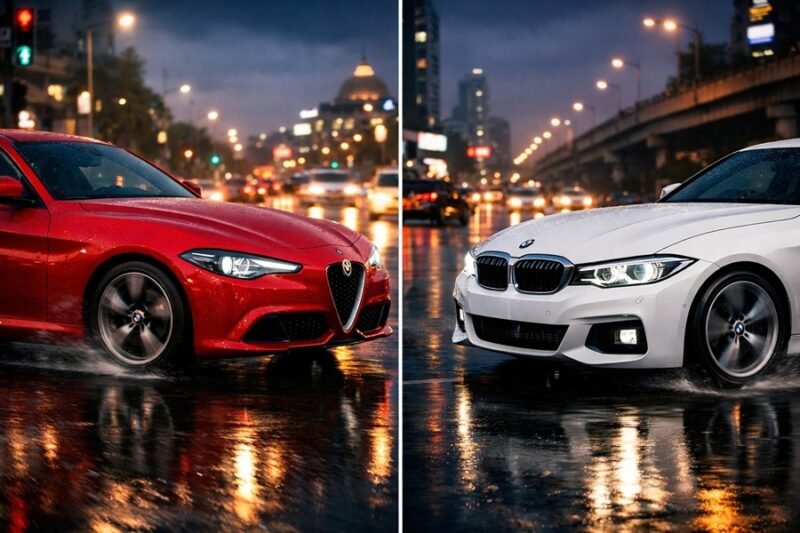
There’s a particular kind of tension that lives between Italian passion and German precision. One car is sculpted like a piece of art, built around the pure act of driving. The other is engineered with cold, calculated brilliance—a machine that does everything exceptionally well and almost nothing wrong. Choosing between the Alfa Romeo Giulia and the BMW 3 Series has never been straightforward, even in markets where both cars are well-established.
Now bring Indian roads into the equation—the crumbling tarmac of a monsoon-soaked Mumbai suburb, the grinding stop-go of Bangalore’s outer ring road, the highway stretches of Delhi where you finally get to breathe—and the decision becomes genuinely complicated.
The BMW 3 Series is a known quantity in India. It’s been here for years, carrying a badge that means something at the valet stand, backed by a service network that stretches across the country. The Alfa Romeo Giulia, expected to arrive in India as part of the brand’s anticipated 2026 entry, is the challenger—bizarre, emotionally charged, and asking buyers to trust a network that’s still being built.
Both sedans are compelling. Both occupy the same price band. But they appeal to very different buyers, and on Indian roads specifically, the differences matter more than the spec sheets suggest. This comparison breaks it all down—performance, ride quality, practicality, service, and value—so you can make a genuinely informed call.
Performance: The Italian Soul vs German Composure
Giulia’s Engine and Steering Precision
The Alfa Romeo Giulia’s 2.0-litre turbocharged four-cylinder produces 280 HP, which, on paper, sits comfortably in the same conversation as the BMW 3 Series. On the road, however, the delivery feels distinctly Italian—eager, responsive, with a character that makes you want to find a winding road rather than a straight highway.
What truly separates the Giulia is its steering. Alfa Romeo engineered the car with the quickest steering rack in this class, providing a direct, almost telepathic connection between your hands and the front wheels. This isn’t a car that steers for you. It’s a car that communicates with you. Pair that with a near-perfect 50/50 weight distribution (achieved through precise placement of the engine, transmission, and fuel tank), and the Giulia’s handling dynamics are in a league of their own.
Expert Tip: The Giulia’s 50/50 weight balance isn’t marketing copy—it’s the result of deliberate engineering choices, including a rear-wheel-drive layout and aluminum-carbon fiber construction that keeps overall weight low. This translates to genuinely neutral cornering behavior that most sedans in this segment can’t replicate.
BMW 3 Series’ Polished Refinement
The BMW 3 Series, specifically the current G20 generation with its 2.0-litre turbocharged four-cylinder producing around 255 HP, takes a different approach. Where the Giulia is expressive, the 3 Series is composed. Acceleration is strong and linear. The eight-speed automatic gearbox shifts with the kind of seamless efficiency that makes long-distance cruising genuinely relaxing.
BMW’s steering setup is more insulated than the Giulia’s—well-weighted, precise, but less communicative. The 3 Series doesn’t demand driver involvement the way the Giulia does. That’s a deliberate choice, and for many buyers, it’s the right one.
Verdict on Performance: The Giulia wins for driving purists. The 3 Series wins for those who want effortless, all-day composure.
The Reality Check: Indian Roads Don’t Care About Lap Times
This is where the conversation shifts significantly. Track numbers and autobahn performance only tell part of the story. Indian roads add variables that no manufacturer tests for in Stuttgart or Arese.
Ground Clearance and Suspension Tuning
Both the Giulia and the 3 Series have a ground clearance of approximately 145–150mm in their standard configurations, which is honestly modest by Indian standards. The Giulia’s suspension, tuned for sporting character, uses aluminum double wishbones up front and a multi-link setup at the rear. It’s sophisticated, but it’s firm. Very firm on bad surfaces.
The 3 Series, with its slightly softer suspension calibration and longer wheelbase, absorbs road imperfections with more grace. On the kind of broken urban tarmac you’d find on a secondary road in Pune or Chennai, the 3 Series genuinely rides better. The Giulia’s suspension communicates every expansion joint, every pothole edge, every speed bump you underestimate.
Pro Advice: If you’re regularly commuting through pothole-heavy roads, consider opting for the 18-inch wheel package over 19s on either car. Larger wheels look great but significantly reduce your tire’s ability to absorb impacts, and in Indian conditions, that trade-off matters year-round.
Monsoon and Urban Conditions
Here’s the honest truth about rear-wheel-drive sedans and Indian monsoons: they require respect. The Giulia’s rear-drive layout and sporting chassis tuning means you’ll need to be deliberate in slippery conditions. It has traction and stability control, of course, but the underlying dynamic balance of the car is built for driver engagement, not passive safety.
The 3 Series, available with xDrive all-wheel drive in certain variants, provides meaningfully more confidence in wet conditions. For buyers in coastal cities or regions with heavy seasonal rainfall, this matters. The Giulia remains rear-wheel drive in this segment, with no xDrive equivalent.
Practical reality: The BMW 3 Series handles Indian road conditions more comfortably day-to-day. The Giulia rewards skill but punishes inattention on bad surfaces.
Beyond just driving dynamics, both manufacturers prioritize structural integrity. For instance, the Alfa Romeo Giulia’s global safety ratings reflect its advanced aluminum-carbon fiber construction, matching the rigorous standards set by its German rivals.
Quick Comparison: Giulia vs 3 Series Specs at a Glance
| Feature | Alfa Romeo Giulia | BMW 3 Series |
| Engine | 2.0L Turbo, 280 HP | 2.0L Turbo, ~255 HP |
| Drivetrain | Rear-wheel drive | RWD / xDrive AWD |
| Transmission | 8-speed automatic | 8-speed automatic |
| Weight Distribution | 50/50 | ~50/50 |
| Ground Clearance | ~145mm | ~140–150mm |
| Steering Feel | Best-in-class, highly responsive | Precise but insulated |
| Suspension Comfort | Firm (sporty bias) | Balanced (comfort-sport) |
| Expected India Price | ₹45–55 lakh | ₹57–65 lakh (approx.) |
| Service Network in India | Being established (Stellantis infrastructure) | Extensive, well-established |
| Warranty | Varies by market | 3 years standard |
Prices are indicative. For the most current Alfa Romeo car price in India 2026, check the dedicated pricing guide.
Design and Interior: Passion vs Precision
Walk around the Giulia and the reaction is immediate. The Scudetto grille, the muscular rear haunches, the teardrop roofline—it reads as genuinely Italian, not just European. Inside, the cabin is driver-focused in the most literal sense: controls are angled toward the driver’s seat, and the overall layout reinforces that this car exists primarily for the person behind the wheel.
The 3 Series interior is, in a word, better. The materials are exceptional, the technology integration is seamless, and the iDrive infotainment system remains among the best in the segment. Rear-seat space is more generous, and build quality consistency is simply more reliable across all vehicles. This isn’t a failing of the Giulia—it’s a reflection of BMW’s decades of volume production experience.
The Giulia’s cabin feels special in a way the 3 Series doesn’t, but the 3 Series is more consistently excellent. If you’re buying this car as a family sedan that happens to be sporty, the BMW wins on interior practicality.
Service and Reliability: The Elephant in the Room
Let’s not sidestep this one. For any luxury car buyer in India, service network quality isn’t a secondary consideration—it’s often the deciding factor.
BMW’s service infrastructure in India is mature and extensive. Authorized service centers exist across all major metros and many tier-2 cities. Parts availability is generally reliable. The brand has been operating in India long enough to have established clear processes, trained technicians, and reasonable turnaround times.
Alfa Romeo’s service situation in India is, at this stage, still being built. Stellantis (Alfa Romeo’s parent company) has an existing footprint through Jeep and Citroën, which provides a foundation. However, servicing a Giulia requires specialized knowledge and tools that are distinct from those used for mass-market Stellantis brands. Before purchasing, confirm which Alfa Romeo showroom in India is nearest to your city, and specifically ask about technician training and parts availability timelines.
Expert Tip: When evaluating any newly launched luxury brand in India, ask the dealer two specific questions before signing anything: “What is your average parts delivery time for non-stock items?” and “How many technicians have undergone brand-certified training?” The answers will tell you more than any brochure.
Is Alfa Romeo reliable in India? Modern Alfa Romeo vehicles—particularly those built on Stellantis’s latest platforms—have significantly improved in build quality compared to the brand’s historical reputation. However, the Giulia’s complexity and the relative novelty of the Indian service network mean that ownership experience will vary more than with a 3 Series. Extended warranties and service packages are strongly recommended.
Value Proposition: Which Car Makes More Financial Sense?
The BMW 3 Series currently sells in India at approximately ₹57–65 lakh (on-road, depending on variant). The Alfa Romeo Giulia, expected at ₹45–55 lakh based on its anticipated CBU import pricing, could represent a genuine value proposition—a more exclusive, more involving car at a competitive price point.
However, total cost of ownership is a broader calculation. Depreciation on the 3 Series is relatively predictable given strong resale demand. Giulia residuals in India are unknown quantities at this stage—bizarre cars from newer brands don’t always hold value well in markets where the service network is limited.
On the flip side, exclusivity has its own currency. If standing out matters to you, the Giulia will do it far more effectively than another 3 Series in the apartment parking lot.
Frequently Asked Questions
Is the Alfa Romeo Giulia suitable for daily use in Indian cities?
Yes, but with caveats. Its firm suspension and rear-wheel-drive layout mean it requires more driver attention in congested, pothole-heavy conditions than the 3 Series. Air conditioning, fuel efficiency, and urban usability are all adequate—but it rewards drivers who are willing to be engaged rather than passive.
Which car has better resale value in India?
Currently, the BMW 3 Series holds significantly better resale value in India, supported by brand recognition and an established used-car market. The Giulia’s resale trajectory in India will take several years to establish. This is an important consideration for buyers on a five-year ownership cycle.
Does the BMW 3 Series come with all-wheel drive in India?
Select variants of the BMW 3 Series are available with xDrive all-wheel drive in India. This makes a meaningful difference in wet or slippery conditions and is worth considering for buyers in high-rainfall regions.
Which car is faster in real-world driving conditions?
On a clean, dry road, the Giulia’s sharper steering and lighter weight give it a more exciting feel. In absolute acceleration, the difference is marginal. In Indian traffic, neither car’s performance advantage is meaningful—but the Giulia feels more alive even at moderate speeds.
What is the expected Alfa Romeo Giulia price in India 2026?
Based on import duty calculations and Stellantis’s pricing strategy for other brands, the Giulia is expected to be priced between ₹45–55 lakh. Final pricing will depend on whether it arrives as a CBU import or through partial local assembly.
The Verdict: Buy the Giulia If… Buy the 3 Series If…
Buy the Alfa Romeo Giulia if you are a driving enthusiast who prioritizes steering feel, chassis balance, and emotional connection over all-round practicality. If you live primarily in a metro with access to an established Alfa Romeo service center, don’t cover extremely high annual mileage, and genuinely value owning something rare and distinctive—the Giulia is the more compelling machine. It’s the kind of car you’ll still want to drive after three years, not just own.
Buy the BMW 3 Series if you need a luxury sedan that excels in every dimension without asking anything difficult of you. Better ride comfort on broken surfaces, a deeper service network, superior resale value, and technology that works flawlessly every time—the 3 Series earns its reputation daily. It’s the smarter, more pragmatic choice for buyers who want a genuinely premium ownership experience with minimal compromise.
Both cars deserve to share India’s roads. But they’re asking for different things in return.
