

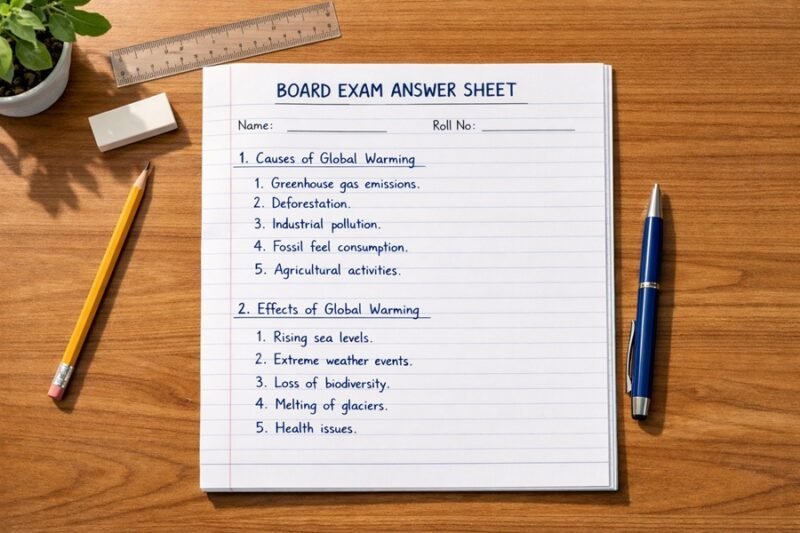
Key Takeaways: Master Board Exam Answer Writing
| What You Need to Know | How to Do It |
| Start with Keywords | Use exact terms from the question in your first line |
| Structure Matters | Follow Introduction → Points → Diagram → Conclusion format |
| Presentation Counts | Write neatly, underline headings, leave margins |
| Time Management | Allocate marks-per-minute (1 mark = 1.5 minutes) |
| Practice is Non-Negotiable | Write 3-5 full answers daily for 30 days before exams |
Scoring above 90% in board exams isn’t about studying harder—it’s about writing smarter. After mentoring hundreds of students through CBSE Class 10 and Class 12 boards, I’ve seen average performers transform into toppers simply by changing how they present their answers. The difference between an 85% student and a 95% student often lies not in what they know, but in how they write what they know.
This guide reveals the exact answer-writing techniques that board examiners reward with full marks. These aren’t theoretical tips—they’re battle-tested strategies that work across all subjects, from Mathematics to English Literature.
Every year, lakhs of students lose marks not because they don’t know the answer — but because they don’t know how to present it.
Why Answer Presentation Determines Your Board Exam Score
Board examiners spend approximately 2-3 minutes evaluating each answer. That’s all the time you have to convince them you deserve full marks. During those critical minutes, they’re not just checking if your content is correct—they’re assessing how well you’ve communicated that knowledge.
The CBSE marking scheme specifically allocates marks for presentation, structure, and clarity. Students who master answer-writing techniques consistently score 8-10% higher than equally knowledgeable peers who present their answers poorly.
Understanding the Board Exam Marking System
Before learning how to write answers in board exams, understand what examiners look for:
Keyword Recognition: Examiners scan for specific terms from the marking scheme. If your answer contains these keywords in the first few lines, you’re already ahead.
Structural Clarity: Well-organized answers with clear headings and point-wise explanations signal a prepared student who deserves full marks.
Relevance and Precision: Rambling answers lose marks. Every sentence must directly address the question asked.
Visual Appeal: Neat handwriting, proper spacing, and organized layouts create positive first impressions that influence scoring.
How to Write Answers in Board Exams: The 5-Step Framework
Step 1: How to Write Answers in Board Exams: Step 1 – Decode the Question
The biggest mistake students make is jumping straight into writing. Spend 30 seconds analyzing each question.
Identify Command Words: Words like “explain,” “describe,” “analyze,” or “compare” tell you exactly what format your answer needs. “Explain” requires cause-effect relationships. “Describe” needs detailed characteristics. “Analyze” demands critical examination with pros and cons.
Circle Keywords: Underline the main subject, time period, or specific aspect the question asks about. If the question asks about “the impact of globalization on Indian agriculture since 1991,” your answer must address all three elements: globalization, Indian agriculture, and the post-1991 period.
Check Mark Allocation: A 5-mark question needs approximately 5-7 substantial points or one detailed explanation with examples. Never write a one-line answer for a 5-mark question or a full-page essay for a 2-mark question.
Step 2: Structure Your Answer Like a Pro
Every answer, regardless of subject, benefits from this proven structure:
Opening Line (The Hook): Start with a direct answer or definition that includes keywords from the question. This immediately shows the examiner you understand what’s being asked.
For a question like “Explain the causes of World War I,” begin with: “World War I (1914-1918) was caused by a complex interplay of militarism, alliances, imperialism, and nationalism, collectively known as the MAIN causes.”
Body (The Substance): Break your main content into numbered or bulleted points. Each point should be a complete idea with explanation and example.
Use subheadings for longer answers (5+ marks). This makes your answer easier to evaluate and shows organizational skill.
Conclusion (The Closure): End with a summary sentence or the significance of what you’ve explained. This demonstrates comprehensive understanding beyond rote memorization.
Step 3: Apply Subject-Specific Writing Techniques
How to Write Answers in Board Exams for CBSE Subjects:
Mathematics: Show every step of your calculation. Even if your final answer is wrong, you’ll earn partial marks for correct methodology. Box your final answers. Draw diagrams with a pencil and scale where required. Label all parts clearly.
Science (Physics, Chemistry, Biology): Include well-labeled diagrams wherever possible—they’re worth significant marks. Use scientific terminology precisely. For example, write “photosynthesis” not “the process by which plants make food.” State laws, principles, or theories before applying them. Show units in all calculations.
Social Science (History, Geography, Civics): Begin with contextual background (when/where). Use dates, names of leaders, and specific events. Include maps for geography answers about location or distribution. Connect cause and effect explicitly using phrases like “This led to,” “As a result,” or “Consequently.”
English: For literature answers, always include relevant quotes from the text in quotation marks. This proves you’ve studied the material thoroughly. Analyze themes, character motivations, and literary devices rather than just retelling the plot. For writing sections (letters, articles, essays), follow the prescribed format strictly—marks are allocated for format adherence.
Step 4: Master the Art of Presentation
Your answer’s visual appeal influences the examiner’s perception before they even read the content.
Handwriting Standards: Write legibly in a consistent size. If your natural handwriting is poor, practice writing slowly and deliberately for 15 minutes daily. Leave adequate spacing between lines (skip one line between answers, half a line between points). This makes your answer appear organized and easy to read.
Strategic Use of Formatting: Underline all headings and subheadings with a scale. Use bullet points or numbering for multiple points—this makes marking easier for examiners. Highlight important terms, definitions, or formulas by underlining them once. Never use colored pens or highlighters in board exams—it’s against regulations.
Margin Discipline: Maintain a 1-inch margin on the left side of every page. Never write in the margins—leave them completely blank for examiner comments. If you need to add information later, use the blank pages at the end of your answer booklet and clearly reference it.
Step 5: Implement Smart Time Management
How to Write Board Exam Papers in Class 10 Without Running Out of Time:
Create a time allocation strategy before the exam begins. Spend the first 15 minutes reading the entire paper and planning your approach.
The Marks-to-Minutes Formula: Allocate 1.5 minutes per mark. A 5-mark question gets 7-8 minutes. A 1-mark question gets 1.5 minutes. This includes thinking and writing time.
Strategic Question Selection: Start with questions you’re most confident about. This builds momentum and ensures you secure easy marks first. Tackle lengthy or difficult questions in the middle when your concentration is strongest. Save questions requiring creativity (like English essays) for later when time pressure can actually enhance focus.
The 10-Minute Reserve: Always reserve the last 10 minutes for review. Check that you’ve attempted all required questions. Verify calculations and ensure you haven’t made silly mistakes. Add any critical points you may have missed.
Advanced Answer Writing Techniques for 90%+ Scores
The Introduction-Body-Conclusion Template for Long Answers:
For answers worth 5-8 marks, use this template:
Introduction (2 lines): Direct answer + brief context
Body (5-7 points): Each point with explanation + example
Conclusion (1-2 lines): Significance or summary
This structure works universally across subjects and question types.
The Comparative Answer Strategy:
When questions ask you to “compare” or “differentiate,” create a two-column format or use “whereas” statements:
“Mitosis results in two identical daughter cells, whereas meiosis produces four genetically diverse gametes. Mitosis maintains the chromosome number, whereas meiosis reduces it by half.”
The Cause-Effect-Solution Framework:
For questions about problems, challenges, or issues:
- Causes (Why did this happen?)
- Effects (What were the consequences?)
- Solutions (How can this be addressed?)
This demonstrates analytical thinking that examiners reward generously.
How to Write Long Answers in English Board Exams
English long-answer questions (literature and writing) require specific strategies:
Literature Answers (Character sketches, theme analysis, chapter questions):
Reference the text directly. Use at least 2-3 relevant quotations per 5-mark answer. Analyze, don’t summarize. Explain why the author made certain choices, what themes are explored, how characters develop. Connect to broader themes. Show how specific elements relate to the work’s overall message or social commentary.
Writing Answers (Essays, articles, letters, stories):
Follow the prescribed format exactly. Format errors cost you marks immediately. Plan before writing. Spend 3-4 minutes creating a brief outline of your main points. Use varied vocabulary and sentence structures. This demonstrates language proficiency. Include an engaging introduction and satisfying conclusion. The middle can be perfect, but weak bookends lower your score.
Common Mistakes That Cost You Marks
Overwriting: More words don’t equal more marks. A concise, well-structured 3-page answer often scores higher than a rambling 6-page response.
Ignoring the Question: Answer what’s asked, not what you wish was asked. If the question says “explain three causes,” don’t write about effects or solutions.
Poor Diagram Quality: Rough, unlabeled diagrams suggest carelessness. Always use a pencil, scale, and proper labels for scientific diagrams.
Skipping Questions: Leaving questions blank guarantees zero marks. Even a partially correct attempt can earn you some marks.
Illegible Handwriting: If the examiner can’t read your answer, they can’t give you marks. Clarity matters more than speed.
The 30-Day Answer Writing Practice Plan
Weeks 1-2: Foundation Building
- Practice writing 3 answers daily from previous year papers
- Focus on structure and presentation, not speed
- Time yourself and gradually reduce completion time
- Review model answers to understand expected quality
Weeks 3-4: Speed and Refinement
- Write 5 answers daily under timed conditions
- Practice complete papers (3 hours) twice per week
- Get feedback from teachers on your answer presentation
- Identify and work on your weakest subject areas
Week 5 (Exam Week): Fine-Tuning
- Write 2-3 complete mock papers under exam conditions
- Focus on time management and question selection strategies
- Review your most common mistakes and consciously avoid them
- Visualize yourself writing confidently during the actual exam
Pro Tips From Board Exam Toppers
The First Impression Strategy: “
I always put my best answer first, even if it wasn’t the first question. This created a strong positive impression that carried through the rest of my paper.” – Priya S., CBSE Class 12 Topper (98%)
The Diagram Advantage: “I made it a point to include at least one diagram in every 5-mark science answer, even when not explicitly asked. Examiners appreciate visual explanations.” – Rahul M., Class 10 Science (100/100)
The Keyword Highlighting Technique: “I underlined important terms and definitions once in every answer. This made it easy for examiners to spot key concepts quickly.” – Anjali K., Class 12 English (99/100)
Answer These Questions to Test Your Readiness
Can you complete a full 3-hour board exam paper with 10 minutes to spare? If not, you need more timed practice.
Do you start every answer with a clear, direct response that includes question keywords? This technique alone can boost your score by 5-7%.
Have you practiced writing at least 50 full answers before your exam? This is the minimum threshold for developing muscle memory and confidence.
Your Path to 90%+ Starts With One Answer
The journey to board exam excellence begins with mastering one answer at a time. Start today by picking a previous year’s question paper, selecting one 5-mark question, and writing the perfect answer using the framework in this guide.
Time yourself. Structure it properly. Present it beautifully. Then compare it with the model answer.
Repeat this process daily for 30 days, and you’ll walk into your board exam with the confidence and skill set of a topper. Your 90%+ score isn’t about luck or last-minute cramming—it’s about systematic preparation and strategic answer writing.
The examiners are waiting to reward you with full marks. Give them exactly what they’re looking for.
Frequently Asked Questions
How many pages should I write for a 5-mark question in board exams?
Write 1.5 to 2 pages for a 5-mark question. Quality matters more than quantity. A well-structured, point-wise answer with relevant examples across 1.5 pages will score higher than a rambling 3-page response with repetitive information.
Should I write answers in point form or paragraph form in CBSE board exams?
Use point form (numbered or bulleted) for questions asking for multiple causes, features, or differences. Use paragraph form for explanatory questions requiring detailed descriptions or analysis. When in doubt, structured points with brief explanations work best.
How can I improve my handwriting speed for board exams?
Practice writing continuously for 30 minutes daily without stopping. Focus on maintaining consistent letter size and spacing rather than speed initially. Speed naturally improves with regular practice while maintaining legibility.
What should I do if I don’t know the complete answer to a question?
Write whatever you know in a structured format. Use logical reasoning to deduce related points. Never leave questions blank—partial attempts earn partial marks, blank answers earn zero.
Reviewed by: Tanmoy Ghos, 12+ years CBSE experience (SBPS)
Read Also: FA2 Question Paper Class 10 2018: Your Complete Practice Guide
