


Over fifteen centuries ago, a silence fell over the mountains of China, broken only by the steady breath of a man seeking the impossible. What is the Indian Legend Regarding the Discovery of Tea? It begins with Bodhidharma, a prince turned monk, who had traveled from India not for conquest, but for clarity. Leaving behind the comforts of royalty, he sought the ultimate awakening, committing himself to a meditation that would last nine years without interruption.
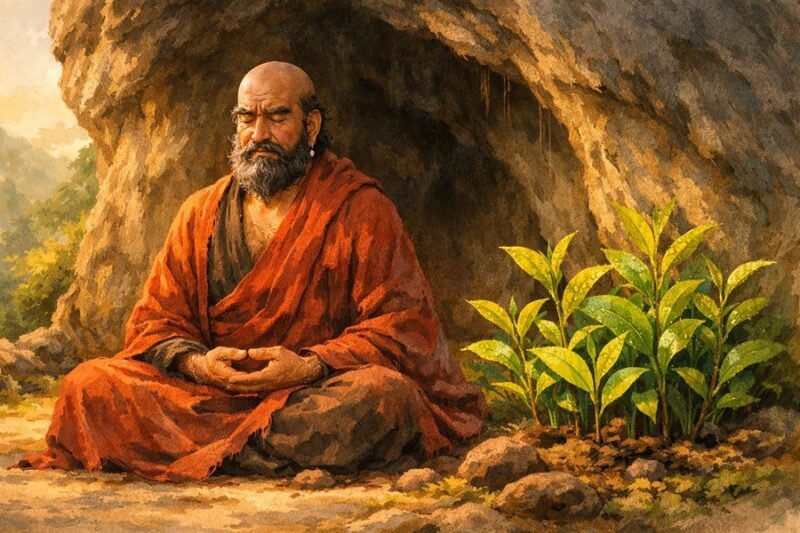
According to ancient Indian legend, tea was discovered by Prince Bodhidharma, a monk from the Pallava dynasty who founded Zen Buddhism. During his nine-year meditation vow in China during the 5th century, he cut off his eyelids to stay awake—and from where they fell, the first tea plants grew.
Key Takeaways:
| Aspect | Legend | Historical Context |
| Protagonist | Prince Bodhidharma, Indian monk and founder of Zen Buddhism | Tea cultivation existed in both India and China independently |
| Time Period | 5th century CE | Tea drinking dates back to at least 2737 BCE in China |
| Discovery Method | Tea plants grew from Bodhidharma’s severed eyelids | Wild tea trees (Camellia sinensis var. assamica) native to Assam, India |
| Symbolic Meaning | Vigilance, mindfulness, spiritual awakening | Medicinal and social beverage across cultures |
| Geographic Origin | Journey from India to China | Indigenous to both regions with distinct varieties |
Tea holds a sacred place in cultures across Asia, but few stories capture its mystical origins quite like the Indian legend of Bodhidharma. This tale weaves together spirituality, determination, and the serendipitous birth of one of the world’s most beloved beverages.
While historians debate the factual accuracy of this legend, its cultural resonance speaks to something deeper: the connection between tea and the practice of mindfulness that remains central to Indian and Buddhist philosophy. Understanding this story offers insight not just into tea’s past, but into why it continues to hold such profound meaning for millions of practitioners and enthusiasts worldwide.

The Journey of Prince Bodhidharma
Bodhidharma wasn’t an ordinary monk. Born into the Pallava dynasty in southern India, he renounced his royal heritage to pursue spiritual enlightenment. His journey to China in the 5th century CE would forever change the landscape of Buddhism—and, according to legend, introduce the world to tea.
The prince arrived in China with an ambitious goal: to spread the teachings of dhyana, or meditative absorption. He eventually settled at the Shaolin Temple, where he committed to an extraordinary feat of endurance—nine years of continuous meditation facing a cave wall, without once succumbing to sleep.
The Struggle Against Sleep
Meditation requires discipline, but nine years without rest tests the limits of human endurance. As the legend tells it, Bodhidharma battled exhaustion daily. His eyelids grew heavy. His mind began to wander. The very sleep he fought against threatened to undermine his spiritual practice.
Frustrated with his body’s weakness and determined to honor his vow, Bodhidharma made a drastic decision. He sliced off his own eyelids and cast them to the ground, ensuring he could never close his eyes again.
Where Eyelids Fell, Tea Plants Grew
What happened next transformed this story from one of determination into one of miraculous discovery. Where Bodhidharma’s eyelids touched the earth, two plants sprouted—the first tea bushes. Their leaves bore a striking resemblance to the shape of eyelids, dark green and slightly curved.
Curious about these unusual plants, Bodhidharma plucked a few leaves and chewed them. The effect was immediate and profound. His fatigue vanished. His mind sharpened with unprecedented clarity. The fog of exhaustion lifted, replaced by vibrant alertness that allowed him to complete his meditation with renewed vigor.
The monk had discovered tea—not through cultivation or accident, but through sacrifice and divine intervention.
The Spiritual Significance of Tea in Indian Culture
This legend connects tea intrinsically with the concepts of vigilance and mindfulness that form the foundation of both Hindu and Buddhist spiritual practices. The beverage became more than refreshment; it represented the tools necessary for spiritual awakening.
Tea as a Meditation Aid
Indian monks and spiritual practitioners embraced tea as an essential companion to meditation. The caffeine naturally present in tea leaves provided sustained alertness without the jittery effects of other stimulants. This allowed practitioners to maintain the delicate balance between relaxation and awareness required for deep meditation.
Many ashrams and monasteries in India continue this tradition, serving tea before and during long meditation sessions. The ritual of preparing and drinking tea itself becomes a form of mindfulness practice—a way to center the mind before deeper spiritual work.
Symbolism of the Eyelids
The imagery of eyelids in the Bodhidharma legend carries profound symbolic weight. Eyelids represent the barrier between wakefulness and sleep, between clarity and confusion, between enlightenment and ignorance. By sacrificing his eyelids, Bodhidharma symbolically removed the obstacles to continuous awareness.
The tea plant that grew from this sacrifice became a physical manifestation of vigilance—a gift that allows others to pursue spiritual awakening without such extreme measures.
Myth Versus Science: The Botanical Reality
While the Bodhidharma legend captures the imagination, botanical evidence tells a different story about tea’s origins. The tea plant, Camellia sinensis, has two main varieties with distinct geographic roots.
He sat facing a cold cave wall, his will forged in iron. He vowed that his eyes would not close, nor his body rest, until enlightenment was his. But the body is frail, even when the spirit is willing. As years dissolved into seasons, the heavy fog of exhaustion began to descend. His eyelids grew heavy, betraying his resolve, threatening to drag him into the dark oblivion of sleep.
Frustration surged through him. In a moment of fierce, desperate discipline, Bodhidharma refused to let his physiology dictate his spiritual fate. With a swift, agonizing motion, he severed his own eyelids and cast them to the rocky earth—a bloody, permanent sacrifice ensuring his gaze would remain forever open.
The Assamica Variety: India’s Native Tea
Camellia sinensis var. assamica is indigenous to the Assam region of northeastern India. These large-leafed trees grew wild in the region’s forests long before recorded history. British colonists “discovered” these wild tea trees in the 1820s, though local guilds had been consuming tea preparations for generations.
This indigenous presence suggests that tea was known and used in India independently of Chinese influence, lending some credibility to legends of Indian tea discovery—if not the specific details of the Bodhidharma story.
The Chinese Connection
China cultivated the smaller-leafed Camellia sinensis var. sinensis as early as 2737 BCE, according to Chinese texts. The Shennong legend—in which the legendary Chinese emperor discovered tea when leaves accidentally fell into his boiling water—predates the Bodhidharma story by millennia.
Historical records suggest tea cultivation and consumption were well-established practices in both regions before Bodhidharma’s journey, making the legend more symbolic than literal.
Expert Insight: Why This Legend Endures
Dr. Mira Patel, a scholar of South Asian religious studies, explains: “The Bodhidharma legend persists not because of historical accuracy, but because it encapsulates the relationship between tea and spiritual practice in Indian culture. The story teaches that enlightenment requires sacrifice, vigilance, and sometimes, a little help from nature.”
Unlike the Chinese Shennong myth, which frames tea discovery as a fortunate accident, the Bodhidharma legend emphasizes intentionality and spiritual purpose. This distinction reveals cultural differences in how societies understand the role of tea—as mere beverage versus spiritual tool.
The Indian legend also connects tea explicitly to the practice of meditation in a way the Chinese origin story does not. For practitioners of Buddhism and yoga, this connection makes the Bodhidharma tale particularly meaningful, regardless of its historical veracity.
The Legacy of Bodhidharma’s Tea
The influence of this legend extends beyond storytelling. Tea ceremonies in Zen Buddhism bear Bodhidharma’s fingerprints, emphasizing mindfulness and presence. The Japanese tea ceremony, descended from Zen practices, transforms the simple act of preparing tea into a meditation on impermanence and awareness.
Indian chai culture, though more casual than Japanese tea ceremonies, maintains threads of this contemplative tradition. The practice of taking a tea break—whether in a bustling Mumbai office or a quiet Himalayan monastery—creates space for pause and reflection amid the demands of daily life.
Frequently Asked Questions
Who discovered tea in India?
According to legend, Prince Bodhidharma, an Indian monk from the Pallava dynasty, discovered tea in the 5th century during his meditation journey in China. However, botanical evidence shows that tea plants (Camellia sinensis var. assamica) are native to India’s Assam region and were likely used by local populations long before this period.
Is the Bodhidharma story true?
The Bodhidharma legend is considered a spiritual allegory rather than historical fact. While Bodhidharma was a real historical figure who founded Zen Buddhism, the story of his eyelids becoming tea plants is symbolic. It represents the connection between tea and the practice of vigilance in meditation.
What is the difference between the Indian and Chinese tea origin stories?
The Chinese legend attributes tea’s discovery to Emperor Shennong around 2737 BCE, when tea leaves accidentally fell into his boiling water. The Indian legend credits Bodhidharma centuries later, emphasizing spiritual purpose and sacrifice. The Chinese story frames discovery as serendipitous, while the Indian version connects it directly to meditation practice.
Why is tea important in Buddhist practice?
Tea helps practitioners maintain alertness during long meditation sessions without causing agitation. The ritual of preparing and consuming tea also serves as a mindfulness exercise, bringing awareness to simple actions. This dual purpose—practical stimulant and meditation tool—makes tea integral to Buddhist spiritual practice.
Experience the Legend for Yourself
The story of Bodhidharma reminds us that tea is more than a beverage—it’s a bridge between the physical and spiritual, between exhaustion and clarity, between sleeping through life and living with full awareness.
Whether you approach this legend as historical truth, cultural metaphor, or spiritual teaching, its core message remains relevant: mindfulness requires effort, dedication, and sometimes, the right tools to support our practice.
Consider exploring authentic Indian single-origin teas, particularly varieties from Assam where wild tea trees still grow. As you steep those leaves and inhale their aroma, you’re participating in a tradition thousands of years old—one born, according to legend, from a monk’s unwavering commitment to awakening.
The next time you sip your morning tea, pause. Notice the warmth of the cup, the subtle flavors dancing across your palate, the gentle alertness spreading through your mind. In that moment, you’re experiencing exactly what Bodhidharma discovered all those centuries ago: tea’s remarkable ability to help us stay present, awake, and fully alive.
Must Read: How to Relax: 15 Proven Ways to Relieve Stress and Ease Anxiety Naturally
Experience the Legend in Every Sip
Bodhidharma’s story reminds us that tea is more than a beverage—it’s a bridge to mindfulness. Explore authentic Indian single-origin teas, particularly varieties from Assam where wild tea trees still grow. Start your journey to alertness and clarity today.
