

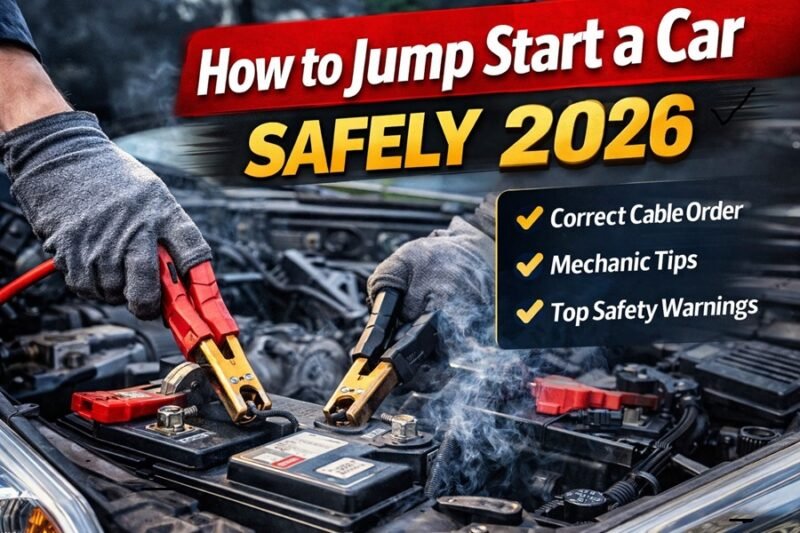
Knowing how to jump start a car properly can save you hours of frustration and hundreds of dollars in towing fees. It happens to the best of us. You turn the key or push the start button, and instead of the reassuring roar of an engine, you hear the dreaded click-click-click or—worse—nothing at all. A dead battery is one of the most common reasons for roadside assistance calls. In my 15 years as an ASE-certified technician, I’ve rescued hundreds of drivers stranded in parking lots, driveways, and on the side of the highway simply because they didn’t know how to jump start a car safely.
While it might seem like a basic skill, getting it wrong can be dangerous. Modern vehicles are packed with sensitive electronics, and an improper connection can fry an onboard computer or, in rare cases, cause the battery to explode. But don’t panic. With the right tools and a bit of knowledge, you can get back on the road in minutes.
This guide will walk you through the proper way to jump start a car, explaining not just the what, but the why behind every step to keep you and your vehicle safe.
Safety First: Before You Open the Hood
Before we even touch the cables, we need to assess the situation. As a mechanic, I never rush into an electrical repair, and neither should you.
Check the Battery’s Physical Condition
Pop the hood and look at the battery. If you see any of the following, STOP . Do not attempt to jump start the car. Call a professional or a tow truck immediately.
- Cracks or leaks:If the battery case is damaged or leaking acid, a spark could ignite explosive gases.
- Frozen battery:If it’s extremely cold outside and the battery sides look swollen, the fluid inside might be frozen. Jumping a frozen battery can cause it to explode.
- Corrosion:A little white powder is fine (we can clean that), but if the terminals are buried in a mountain of corrosion, you won’t get a good connection.
Protect Your Eyes and Skin
Car batteries contain sulfuric acid and produce hydrogen gas. I always keep a pair of safety glasses in my glovebox for this exact reason. If you have them, wear them. Avoid leaning directly over the battery when making connections.
Secure the Vehicles
Make sure both cars are in Park (or Neutral for manual transmissions) with the parking brakes firmly set. Turn off the ignition, lights, and accessories (A/C, radio, phone chargers) in both vehicles to prevent electrical surges.
Tools You Need
To jump start a car battery, you really only need one essential tool, but a few extras help:
- Jumper Cables:Look for a set with a lower gauge number (4-gauge or 6-gauge is standard for most cars; 2-gauge is better for trucks). Thicker cables conduct electricity better.
- A Working Vehicle (Donor Car):A car with a battery of similar voltage (usually 12V).
- Wire Brush or Rag (Optional):To clean off dirty terminals for a better connection.
- Safety Glasses and Gloves (Recommended):For personal protection.
Best Jumper Cables for Safe Jump Starting
| Feature | Recommended |
|---|---|
| Gauge | 4 or 6 gauge |
| Length | 16–20 ft |
| Material | Copper core |
| Clamp Type | Heavy-duty insulated |
Investing in thick, heavy-duty jumper cables reduces voltage drop and protects modern vehicle electronics.
The Step-by-Step Process: How to Jump Start a Car with Cables
This is the exact procedure I use in the shop. Follow this jumper cable connection order precisely to minimize the risk of sparks near the battery.
Step 1: Position the Vehicles
Park the working car (the donor) close enough to the dead car so the cables can reach easily, but do not let the vehicles touch. If the metal bodies touch, it can create a dangerous ground path.
Step 2: Identify Positive and Negative
Look at the batteries. You need to identify the Positive (+) and Negative (-) terminals.
- Positive (+):Usually has a red cover, a plus sign, and is slightly larger.
- Negative (-):Usually black, has a minus sign, and is slightly smaller.
Mechanic’s Tip: If the terminals are dirty, wipe them off or use a wire brush. A clean metal-to-metal contact is crucial for the flow of electricity.
Step 3: Connect the Positive Cables (Red)
We always start with the positive cables.
- Take one end of the RED (+) cable and clamp it to the Positive (+) terminal of the dead battery. Make sure the clamp bites into the metal firmly.
- Take the other end of the RED (+) cable and clamp it to the Positive (+) terminal of the working battery
Step 4: Connect the Negative Cables (Black)
This is where people often get confused about how to put on jumper cables. Pay close attention here.
- Take one end of the BLACK (-) cable and clamp it to the Negative (-) terminal of the working battery
- CRITICAL STEP: Take the other end of the BLACK (-) cable and clamp it to an unpainted metal surface on the dead car’s engine block or chassis.
- Why not the negative terminal? Batteries emit hydrogen gas, which is flammable. The final connection often sparks. If you connect it directly to the dead battery, that spark happens right next to the gas source. Connecting to the engine block keeps the spark away from the battery. Good spots include a heavy bolt on the engine, a strut tower bolt, or an unpainted bracket.
For a detailed breakdown of how to jump start a car with jumper cables, read our complete guide.
Step 5: Start the Engines
- Start the working car first. Let it run for a minute or two. This starts charging the working battery so it doesn’t get drained by the dead one.
- Ideally, bring the RPMs up slightly (to about 1,500 – 2,000 RPM) on the working car. This excites the alternator and produces more amperage.
- Now, try to start the dead car
Step 6: Troubleshooting (If It Doesn’t Start)
If the car doesn’t start immediately, don’t keep cranking it. You’ll overheat the starter.
- Wait a few minutes with the donor car running to let the dead battery build up a surface charge.
- Wiggle the cable clamps to ensure they have a solid connection.
- Try starting it again.
If your car still won’t start after a jump, check our detailed guide on how to jump start a car battery when it’s completely dead.
Step 7: Disconnect in Reverse Order
Once the dead car is running, do not turn it off. We need to remove the cables. To do this safely, we remove them in the exact reverse of the jump car battery order we used to put them on.
- Remove the BLACK (-) clamp from the previously dead car (the ground point).
- Remove the BLACK (-) clamp from the working car
- Remove the RED (+) clamp from the working car
- Remove the RED (+) clamp from the previously dead car
Mechanic’s Tip: Be careful not to let the clamps touch each other or any metal surfaces while you are removing them.
Step 8: Keep it Running
Drive the revived car for at least 20 to 30 minutes. Your alternator needs time to recharge the battery. If you shut it off immediately, it likely won’t start again.
Common Mistakes to Avoid
In my line of work, I see a lot of damaged electronics caused by simple mistakes. Here is what to watch out for when learning the proper way to jump start a car.
In my experience as a technician, most failed jump starts happen due to loose cable clamps.
Crossing the Cables (Reverse Polarity)
This is the biggest sin in jump starting. If you connect positive to negative, you create a short circuit. I’ve seen this melt jumper cables, blow main fuses, and even fry engine control units (ECUs). Always double-check the + and – symbols. Red cables aren’t magic; they are just copper wire. The color is there to help you keep track.
Ignoring Cable Quality
Those cheap, thin jumper cables you bought at the gas station for $10? They often don’t carry enough current to start a car, especially a large SUV or truck. The resistance is too high. If the car cranks very slowly even when connected to a donor, your cables might be the bottleneck.
Touching the Clamps Together
Once one end of the cables is connected to a battery, the other ends are “live.” If you touch the red and black clamps together, you are creating a dead short. You will see massive sparks and potentially melt the clamps.
When NOT to Jump Start a Car
Sometimes, jumping the battery isn’t the solution, or it’s unsafe to try.
- The battery is cracked or leaking: As mentioned in the safety section, this is a fire hazard.
- The car has a bad alternator: If the car dies immediately after you remove the jumper cables, your alternator (which charges the battery while driving) is likely dead. A jump start won’t fix this.
- The starter is bad: If you turn the key, the lights are bright, but you hear a single loud “clunk” or nothing at all, the issue might be the starter motor, not the battery.
- Hybrid or Electric Vehicles (EVs): While most EVs have a 12V battery that can be jumped, the process can be different. Never use an EV’s high-voltage system to jump a regular gas car unless the owner’s manual explicitly says it’s okay. You can damage the EV’s expensive electrical system.
Alternative Methods: Jump Starters
While knowing how to jump start a car with cables is essential, technology has given us a better option: the Portable Jump Starter Pack
These are lithium-ion battery packs about the size of a paperback book. I carry one in my truck at all times. They are safer because they often have reverse-polarity protection (they won’t work if you hook them up wrong) and you don’t need a second vehicle.
To use one:
- Connect the pack’s red clamp to Positive (+).
- Connect the black clamp to Negative (-).
- Turn on the pack.
- Start the car.
- Disconnect.
If you are uncomfortable with jumper cables, I highly recommend investing in one of these packs.
Frequently Asked Questions
Can I get electrocuted jump starting a car?
It is extremely unlikely. Car batteries are 12-volt DC systems. While they have high amperage (power), the voltage (pressure) is too low to push dangerous current through human skin under normal dry conditions. However, you can get a nasty burn if your metal ring or watch touches both terminals at once, creating a short circuit.
How long should I let the car run after a jump start?
You should drive the vehicle for at least 20 to 30 minutes. Idling in the driveway charges the battery much slower than driving at highway speeds. If the battery is old (3-5 years), it might not hold the charge and will need replacing.
Does it matter which car I start first?
Yes. You should always start the donor car (the one with the good battery) first. This protects the donor car’s battery from being drained by the dead car’s starter motor.
What if the jumper cables get hot?
If the cables feel hot to the touch, disconnect them immediately (safely). This usually means the cables are too thin for the amount of current being drawn, or there is a bad connection causing resistance. Let them cool down and try re-adjusting the clamps for a better grip.
Can I jump start a car in the rain?
Yes, it is generally safe to jump start a car in the rain, provided you aren’t submerged in water. 12V systems don’t arc through rain the way high-voltage power lines do. However, try to keep the connections as dry as possible to prevent corrosion later, and be careful not to slip on wet pavement.
Confidence is Key
There is no reason to be stranded for hours waiting for a tow truck when you have a set of cables in the trunk. Knowing how to jump start a car is a fundamental skill of car ownership. By following this guide, respecting the electricity, and double-checking your connections, you can tackle a dead battery with the confidence of a pro.
Just remember: Positive to Positive, Negative to Ground. You’ve got this.
If your battery continues to die after being jumped and driven, it’s time to visit a shop. A simple load test can tell you if it’s time to swap out that battery for a new one. Stay safe out there!
Read More: Tata Motors Car Price List in India (2026): A Complete Buyer’s Guide
