

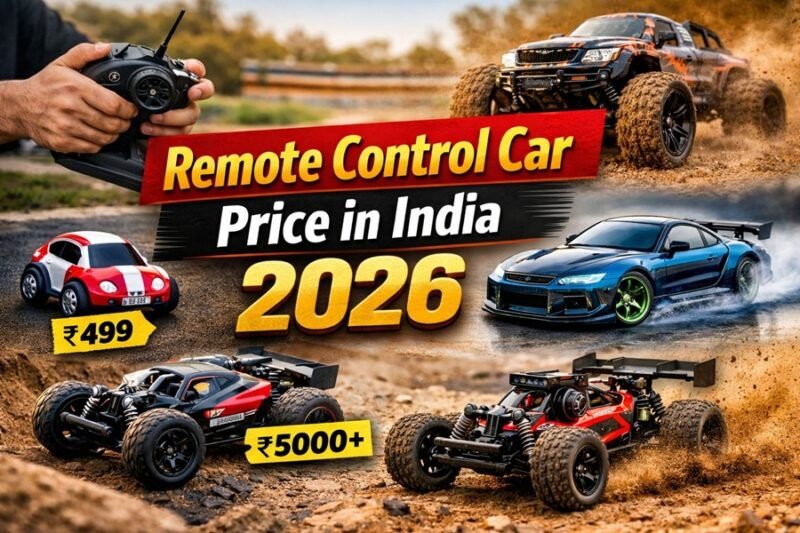
Buying a remote control car online sounds simple enough—until you realize the price range is staggeringly wide. You might see a flashy “high-speed” model for ₹200 and another that looks almost identical for ₹5,000. So, what’s actually worth your money?
I’ve spent the better part of a decade testing everything from palm-sized racers to hobby-grade monsters that require their own toolkits. In India, the market is flooded with options, but quality varies wildly. If you are looking for the right remote control car for your child (or yourself), understanding the price-to-performance ratio is critical.
In this guide, I’ll break down exactly what you get at different price points, what features matter, and which specs are just marketing fluff.
The Real Price Breakdown: What to Expect
When looking at the remote control car price in India, it helps to categorize them by what they can actually do, rather than just what they look like. Here is a realistic breakdown of the market in 2026.
Budget Segment: ₹200 – ₹500
Best for: Toddlers, small indoor spaces, and stocking stuffers.
If you are searching for a remote control car price 200 to 500, you are looking at the entry-level toy segment. These are usually mini remote control car models.
- What you get: Basic forward and backward movement. Some turn left/right, but many in the lower ₹200 range only turn in reverse.
- Build: Lightweight plastic. They survive drops because they are too light to break themselves.
- Battery: AA batteries (non-rechargeable). You will likely spend more on batteries than the car itself over a month.
- My take: A remote control car under 500 is fine for a 3-year-old who just wants to see something move. Don’t expect proportional steering or speed.
Mid-Range: ₹500 – ₹1,500
Best for: Kids aged 5-10, casual play, gifting.
This is the sweet spot for most Indian parents. Here, you start seeing rechargeable battery packs and better designs.
- What you get: Full-function control (forward, back, left, right). Some “stunt” cars with 360-degree rotation fall here.
- Build: Better quality ABS plastic. Tires might still be hard plastic or low-grade rubber.
- Performance: Decent for tiled floors or smooth concrete. They will struggle on grass.
- My take: This is where the “toy” starts feeling fun. If you want a remote control racing car look without the professional price tag, this is your category.
High-Performance: ₹1,500 – ₹5,000
Best for: Older kids, beginners interested in hobby RC, outdoor use.
Now we are getting serious. This bracket introduces suspension, higher speeds, and better radios.
- What you get: 2.4GHz remotes (meaning multiple cars can race without interference), shock absorbers, and sometimes specialized remote control drift cars.
- Build: Metal alloy body parts, rubber tires with grip, and durable chassis.
- Performance: Speeds up to 15–20 km/h. Capable of handling light gravel and carpet.
- My take: If you want a best remote control car in India for a pre-teen that won’t break on day one, aim for the ₹2,000+ mark.
Hobby-Grade & Adult RC: ₹5,000+
Best for: Enthusiasts, modification, competitive racing.
These are remote control cars for adults or serious teen hobbyists.
- What you get: Proportional steering (turn a little, wheel turns a little), brushless motors, and modular parts you can replace.
- Build: Polycarbonate shells, oil-filled shocks, metal differentials.
- Performance: 40+ km/h speeds. They rip through grass, mud, and sand.
- My take: These aren’t toys; they are machines.
Types of Remote Control Cars Available in India
The shape of the car usually dictates what it’s good at. Don’t buy a Ferrari replica if you plan to drive it in the garden.
1. Mini Remote Control Car
These are pocket-sized. I’ve tested models that fit inside a soda can. They are strictly for smooth, indoor surfaces. They are great for quick fun on a dining table but get stuck on thick carpets immediately.
2. Remote Control Racing Car
Modeled after F1 or GT cars, these sit very low to the ground. They are built for speed on flat surfaces (marble, wood, asphalt). They look fantastic but have zero off-road capability.
3. Remote Control Drift Cars
This is a rapidly growing segment. These cars come with hard plastic slick tires designed to lose traction intentionally. They are incredibly fun to slide around a living room, but they require a bit of skill to master. If you buy a dedicated drift car, do not drive it on the road; the rough asphalt will ruin the slick tires in minutes.
4. Off-Road RC Cars (Crawlers and Buggies)
These have high ground clearance and big, knobby tires. Even in the toy grade (₹1,000 range), these are usually the most versatile because they can drive over door thresholds, rugs, and backyard grass without getting stuck.
Technical Specifications: What Numbers Matter?
When browsing Amazon or Flipkart, the spec sheets can be confusing. Here is a cheat sheet based on my testing experience.
| Feature | Toy Grade (Under ₹1500) | Hobby/Pro Grade (Over ₹2000) |
| Motor Type | Brushed (Standard) | Brushless (High Speed/Efficiency) |
| Battery | AA or 500mAh Ni-Cd | 1200mAh – 2000mAh Li-Po |
| Run Time | 10–15 mins | 20–40 mins |
| Charging Time | 2–3 hours | 1–2 hours (with fast chargers) |
| Control Range | 10–20 meters | 50–100 meters |
| Scale | 1:24 / 1:18 | 1:16 / 1:12 / 1:10 |
| Material | Hard Plastic | Nylon / Alloy / Polycarbonate |
My Real-World Performance Experience
I recently took three different rc remote control car models to a local park to see how they handled “Indian conditions”—meaning uneven pavement, patches of grass, and loose dust.
The Budget Test (Under ₹500):
I tried a generic sports car model. On the smooth pavement, it was fine. But the moment it hit a patch of loose dirt, the wheels spun helplessly. The range was also an issue; the car stopped responding about 15 feet away. It’s strictly an indoor toy.
The Mid-Range Test (₹1,200):
I tested a “Rock Crawler” style car here. The difference was night and day. It had spring suspension (albeit stiff) and rubber tires. It climbed over tree roots and handled the grass reasonably well. However, the steering was “bang-bang”—meaning the wheels were either fully left, fully right, or straight. There was no subtle turning.
The High-End Test (₹4,500):
This was a remote control racing car with a metal chassis. The speed was actually startling. I had to be careful not to crash it into ankles because it carried some serious weight and momentum. The battery lasted about 25 minutes of hard driving. The proportional steering made it feel like I was actually driving, not just pressing buttons.
Who Should Buy What?
Don’t overspend if you don’t need to. Here is who needs what:
Buy the Budget/Toy Car (₹200-₹800) If:
- You are buying for a toddler: They will likely sit on it or throw it. Durability matters less than replaceability.
- It’s a small return gift: Great for birthday party favors.
- Space is limited: You only have a small hallway for play.
Buy the Mid-Range (₹800-₹2,000) If:
- You want value: This is the best bang for your buck for kids aged 6-10.
- You need durability: These usually survive being driven down stairs.
- You play outdoors: You need rubber tires and suspension for driveways and parks.
Buy the High-End (₹2,500+) If:
- You are an adult or teen: Remote control cars for adults need speed and precision to remain interesting.
- You want to drift: Good remote control drift cars need power to maintain a slide.
- You like tinkering: Higher-end cars often allow you to upgrade batteries or motors.
Pros & Cons of Owning an RC Car in India
Before you click “buy,” consider the practicalities of owning a remote control toy car here.
Pros:
- Hand-Eye Coordination: Excellent for developing reflexes in kids.
- Outdoor Encouragement: It gets kids off screens and into the park.
- Community: The hobbyist scene in India is growing, with groups meeting on weekends in metro cities.
Cons:
- Battery Management: Most toy-grade cars require 3 hours of charging for 15 minutes of play. I highly recommend buying a model that lets you swap batteries.
- Spare Parts: If you break a wheel on a ₹1,000 car, you can’t buy a spare. You have to buy a new car. Hobby-grade cars have spares, but they are expensive.
- Dust & Debris: Indian roads are dusty. Dust gets into the gears of cheaper cars and can jam the motors over time.
Detailed Buying Guide
If you are ready to make a purchase, keep these four factors in mind.
1. Check the Frequency
Look for “2.4GHz” on the box. Older cars use 27MHz or 49MHz. The problem with those? If you and your neighbor both have 27MHz cars, one remote will control both cars (or neither). 2.4GHz pairs uniquely to your car, allowing you to race friends without interference.
2. Battery Type is King
Avoid cars that require AA batteries for the vehicle itself. You will burn through money. Look for Li-Ion or Ni-Cd rechargeable packs. Pro-tip: Check the mAh rating. A 500mAh battery gives you ~10 minutes. A 1200mAh battery gets you closer to 25 minutes.
3. Indoor vs. Outdoor
If you have marble flooring, a drift car or racing car is great. If you have carpet or plan to use it on the road, get a buggy or monster truck. Low-slung cars get stuck on everything.
4. Spare Parts Availability
For any car costing over ₹3,000, check if the brand sells spare batteries or tires. Brands like WLToys or Tamiya (available via specialized importers) have parts. Generic unbranded cars do not.
FAQs
What is the starting price of remote control car in India?
You can find basic wired remote cars for as low as ₹150. Wireless models typically start at a remote control car price 200 to ₹300 for very basic mini models.
Can adults use remote control cars?
Absolutely. Remote control cars for adults are a massive hobby. These cars can reach speeds of 60 km/h+ and feature complex mechanical engineering similar to real cars.
Which is the best remote control car under ₹500?
At this price point, unbranded “scale model” cars are your best bet. Look for “1:24 scale” models on Amazon or local toy shops. They are basic but look good on a shelf and drive reasonably well on smooth floors.
How long does RC car battery last?
For a standard toy-grade car, expect 15 to 20 minutes of runtime on a full charge. Hobby-grade cars with Li-Po batteries can push this to 30-40 minutes depending on how fast you drive.
Are remote control drift cars good for beginners?
They can be tricky. Drifting requires throttle control and counter-steering. However, many budget drift cars come with hard tires that slide easily at low speeds, which is fun for beginners to learn on smooth tiles.
Must Read: 7 Seater Car Under 10 Lakh: Top Picks for Big Families on a Budget
