

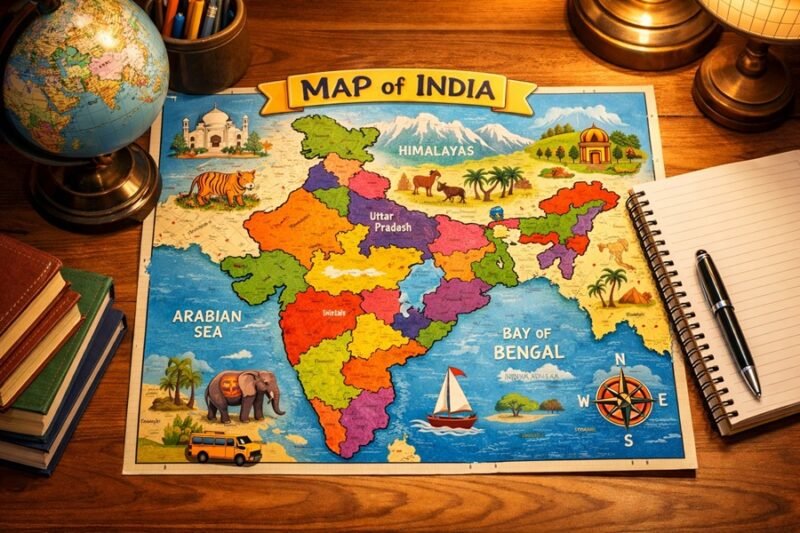
India is a vast and diverse nation, constantly evolving in its geography and administration. For students, competitive exam aspirants, and general knowledge enthusiasts, keeping track of the political map can be confusing. You might be wondering, how many states in India will there be in 2026? Has anything changed recently?
As of now, the structure of India remains stable following the major changes in 2019 and 2020. This guide will walk you through the current list of states, Union Territories, their capitals, and the history behind these changes. Whether you are preparing for UPSC or just brushing up on your GK, we have you covered.
Understanding India’s Political Map
India is a federal union comprising states and union territories. The difference between the two is crucial for understanding the country’s administrative makeup.
- States: These are administrative units with their own elected government (Chief Minister) and legislature. They have significant autonomy in handling local affairs like police, health, and agriculture.
- Union Territories (UTs): These are federal territories governed directly by the Central Government of India through a Lieutenant Governor or Administrator. However, some UTs like Delhi, Puducherry, and Jammu & Kashmir have their own legislatures.
The Current Count
So, how many states are there in India right now?
- Number of States: 28
- Number of Union Territories: 8
This count has been in effect since January 26, 2020, and is expected to remain the same through 2026 unless new parliamentary acts are passed.
Why the Confusion? A Look at Recent History
If you look at older textbooks, you might see the number 29 states and 7 UTs. If you look at even older ones, you might see 28 states and 7 UTs. Why does the number keep changing?
To answer how many states in India 2021 or 2026, we need to look at two major events:
- The J&K Reorganization Act (2019): In August 2019, the state of Jammu and Kashmir was bifurcated into two separate Union Territories: Jammu & Kashmir and Ladakh. This reduced the state count from 29 to 28 and increased the UT count.
- The Merger of Daman & Diu and Dadra & Nagar Haveli (2020): In January 2020, these two separate UTs were merged into a single entity to streamline administration. This reduced the UT count from 9 to 8.
Therefore, the final tally stands at 28 States and 8 Union Territories.
Complete List: How Many States in India Name Them With Capital
For students and aspirants, memorizing the names and capitals is essential. Here is the comprehensive list of the 28 states in alphabetical order.
The 28 States of India
| S.No | State | Capital |
| 1 | Andhra Pradesh | Amaravati |
| 2 | Arunachal Pradesh | Itanagar |
| 3 | Assam | Dispur |
| 4 | Bihar | Patna |
| 5 | Chhattisgarh | Raipur |
| 6 | Goa | Panaji |
| 7 | Gujarat | Gandhinagar |
| 8 | Haryana | Chandigarh |
| 9 | Himachal Pradesh | Shimla |
| 10 | Jharkhand | Ranchi |
| 11 | Karnataka | Bengaluru |
| 12 | Kerala | Thiruvananthapuram |
| 13 | Madhya Pradesh | Bhopal |
| 14 | Maharashtra | Mumbai |
| 15 | Manipur | Imphal |
| 16 | Meghalaya | Shillong |
| 17 | Mizoram | Aizawl |
| 18 | Nagaland | Kohima |
| 19 | Odisha | Bhubaneswar |
| 20 | Punjab | Chandigarh |
| 21 | Rajasthan | Jaipur |
| 22 | Sikkim | Gangtok |
| 23 | Tamil Nadu | Chennai |
| 24 | Telangana | Hyderabad |
| 25 | Tripura | Agartala |
| 26 | Uttar Pradesh | Lucknow |
| 27 | Uttarakhand | Dehradun (Winter), Gairsain (Summer) |
| 28 | West Bengal | Kolkata |

How Many States and Union Territories Are There in India?
While states have their own governments, Union Territories are a unique feature of Indian federalism. When people ask how many states and union territories are there in india, they often forget the specific details of the UTs.
Here is the list of the 8 Union Territories and their capitals:
| S.No | Union Territory | Capital |
| 1 | Andaman and Nicobar Islands | Port Blair |
| 2 | Chandigarh | Chandigarh |
| 3 | Dadra and Nagar Haveli and Daman and Diu | Daman |
| 4 | Delhi (National Capital Territory) | New Delhi |
| 5 | Jammu and Kashmir | Srinagar (Summer), Jammu (Winter) |
| 6 | Ladakh | Leh |
| 7 | Lakshadweep | Kavaratti |
| 8 | Puducherry | Puducherry |
Interesting Facts about Indian States and UTs
- Largest State: Rajasthan (by area).
- Smallest State: Goa (by area).
- Most Populous State: Uttar Pradesh.
- Least Populous State: Sikkim.
- Newest State: Telangana (formed in 2014).
- Shared Capitals: Chandigarh serves as the capital for both Punjab and Haryana, and is also a UT itself.
The Future of Indian States: Will There Be Changes in 2026?
The year 2026 is significant in Indian politics. This is the year when the freeze on the delimitation of parliamentary constituencies is set to be lifted. While this primarily affects the number of Lok Sabha seats, discussions about creating new states often resurface during such political shifts.
Various demands for new states have existed for decades. Some prominent demands include:
- Vidarbha: From Maharashtra.
- Bundelkhand: From parts of Uttar Pradesh and Madhya Pradesh.
- Bodoland: From Assam.
- Gorkhaland: From West Bengal.
However, creating a new state is a complex constitutional process requiring Parliamentary approval. As of today, there are no official bills passed to create a 29th state by 2026. Therefore, for all exams and general knowledge purposes, the answer remains 28 States.
Deep Dive: The Six Zones of India
To better understand the geography and culture, the states are often grouped into zones. This classification is helpful for the Zonal Councils which promote cooperation between states.
1. North India
This region is known for its Himalayas, rich history, and the Indo-Gangetic plains.
- States: Himachal Pradesh, Punjab, Haryana, Rajasthan, Uttarakhand, Uttar Pradesh.
- UTs: Delhi, Jammu & Kashmir, Ladakh, Chandigarh.
2. South India
Famous for its Dravidian culture, temples, and coastline.
- States: Andhra Pradesh, Karnataka, Kerala, Tamil Nadu, Telangana.
- UTs: Puducherry, Lakshadweep, Andaman & Nicobar Islands.
3. East India
The cultural heartland known for literature, minerals, and tea.
- States: Bihar, Jharkhand, Odisha, West Bengal.
4. West India
The industrial and commercial hub of the country.
- States: Goa, Gujarat, Maharashtra.
- UTs: Dadra and Nagar Haveli and Daman and Diu.
5. Central India
The heart of India, rich in forests and wildlife.
- States: Madhya Pradesh, Chhattisgarh.
6. North-East India (The Seven Sisters + Sikkim)
Known for its biodiversity, unique tribal cultures, and scenic beauty.
- States: Arunachal Pradesh, Assam, Manipur, Meghalaya, Mizoram, Nagaland, Tripura, Sikkim.
Importance for Competitive Exams (SSC, UPSC, Railways)
If you are preparing for exams like SSC CGL, UPSC Civil Services, or RRB NTPC, simply knowing the number isn’t enough. You need to understand the nuances. Here are key points to remember:
- Article 1 of the Constitution: Describes India as a “Union of States.”
- Article 3: Empowers the Parliament to form new states and alter areas, boundaries, or names of existing states.
- J&K Reorganization: Remember the dates (Aug 5, 2019 for the bill, Oct 31, 2019 for implementation).
- Dadra & Nagar Haveli Merger: Remember that this came into effect on Jan 26, 2020.
Questions often trick candidates by asking about the status before 2019 versus after 2020. Always check the year mentioned in the question.
Conclusion
Understanding the political map of India is more than just memorizing numbers; it is about understanding the diversity and administrative structure of the world’s largest democracy. As we look toward 2026, the current tally stands firm at 28 States and 8 Union Territories.

Whether you are a student trying to pass your geography test or a citizen wanting to be better informed, knowing these details connects you to the broader story of the nation. Keep this guide handy, and you will never be confused about India’s states again.
Ready to test your knowledge? Pull out a blank political map of India and try to label all 28 states and 8 UTs correctly!
FAQs
1. How many states in India are there currently in 2026?
There are 28 states in India currently. This number has remained stable since the reorganization of Jammu and Kashmir in 2019.
2. Which is the 29th state of India?
Currently, there is no 29th state. Telangana was the 29th state formed in 2014, but after Jammu and Kashmir became a Union Territory in 2019, the total count of states dropped back to 28.
3. What represent the 8 Union Territories of India?
The 8 Union Territories are: Andaman and Nicobar Islands, Chandigarh, Dadra and Nagar Haveli and Daman and Diu, Delhi, Jammu and Kashmir, Ladakh, Lakshadweep, and Puducherry.
4. Are there any plans to create new states before 2026?
While there are long-standing demands for new states like Vidarbha and Gorkhaland, there is no official legislation currently in process to create a new state. The count remains 28.
Read Also: Bharat Bandh Today: Trade Unions Strike Hits Services on Feb 12, 2026
