

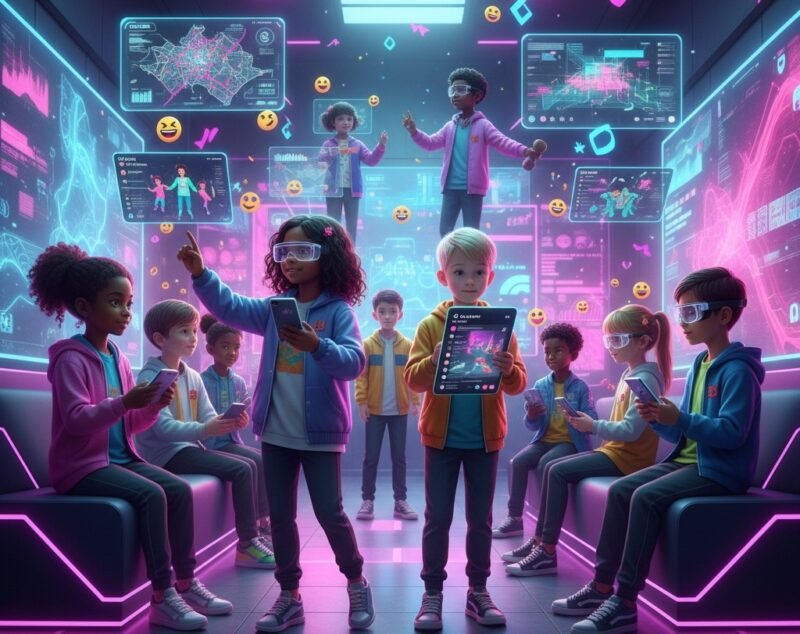
Walk into any restaurant, waiting room, or public transport hub, and you will see them: a child completely absorbed in a tablet, fingers moving with intuitive speed across a glowing screen. This is Generation Alpha. Born between 2010 and 2024, they are the children of Millennials and the younger siblings of Gen Z. But to dismiss them simply as “screen-obsessed” misses the point entirely.
For this cohort, technology isn’t a tool they learned to use; it’s the environment they were born into. They are the first true glass-screen generation. As we look toward the near future, understanding Gen Alpha digital culture 2026 is essential for educators, marketers, and parents alike. This isn’t just about what apps they use; it’s about how their brains are wired to communicate, learn, and play in a hyper-connected world.
Who is Generation Alpha?
Generation Alpha spans birth years from 2010 to roughly the end of 2024. This timing is significant. The iPad was launched in 2010, and Instagram followed shortly after. By the time the oldest Alphas were toddlers, smart devices were ubiquitous. By the time they entered school, the COVID-19 pandemic had normalized remote learning and digital socialization.
Unlike previous generations who migrated to digital platforms, Alphas are digital residents. Their baseline for “normal” includes AI assistants, algorithmic feeds, and on-demand everything.
Key Digital Norms Defining the Generation
To understand where we are heading, we have to look at the behaviors cementing themselves right now. The Gen Alpha digital culture 2026 landscape is being built on several pillars that differentiate them from their predecessors.
The Mobile-First (and Only) Mindset
For many Alphas, a “computer” is a glass rectangle. The concept of a mouse and keyboard feels increasingly foreign compared to the tactile immediacy of a touchscreen. This mobile-first preference dictates how they consume information. If it doesn’t load instantly on a phone or tablet, it effectively doesn’t exist. This shifts user interface design toward swipe-based, gesture-heavy interactions rather than click-based navigation.
Short-Form Dominance: Gen Alpha vs Gen Z Social Media
When comparing Gen Alpha vs Gen Z social media habits, we see a distinct evolution. Gen Z helped popularize YouTube vloggers and the curated aesthetic of Instagram. Gen Alpha, however, gravitates toward the chaos and speed of YouTube Shorts and TikTok.
Their attention span isn’t necessarily “shorter” in a negative sense; it is highly selective. They are experts at filtering information. If the first two seconds of a video don’t deliver a hook, they scroll. This has led to a style of content that is loud, fast-paced, and visually dense.
Brain Rot Content Explained
If you have heard a child referencing “Skibidi Toilet,” “Fanum Tax,” or “Rizz,” you have encountered the unique humor of Gen Alpha. Often labeled by older generations as “brain rot,” this content style is actually a sophisticated form of absurdist, dadaist humor.
Brain rot content explained simply: It is internet culture accelerated. It relies on layers of meta-irony, nonsensical visuals, and rapid-fire references that act as shibboleths—if you get the joke, you are part of the in-group. It prioritizes “vibes” and randomness over linear storytelling, reflecting the chaotic nature of the algorithmic feeds they consume daily.
Roblox Generation Trends and the Metaverse
For Gen Alpha, gaming is not a solitary activity; it is their primary social network. Roblox generation trends indicate that these platforms serve as the “third place”—a social hangout spot separate from home and school.
In worlds like Roblox, Fortnite, and Minecraft, status is digital. They care as much about their avatar’s “skin” (outfit) as they do about their physical clothes. They are learning basic economics through Robux and V-Bucks, trading digital assets with a fluency that often baffles their parents.
The Shift in Education and Learning
The “chalk and talk” method of teaching faces an existential crisis with Gen Alpha. Because they are accustomed to interactive, gamified feedback loops, passive learning feels agonizingly slow.
Educational institutions are realizing that to reach this group, technology cannot just be an add-on; it must be the delivery mechanism. We are seeing a rise in:
- Gamified Learning: Apps that use streaks, badges, and leaderboards to teach math and literacy.
- Visual-First Education: Video tutorials and interactive simulations replacing dense textbooks.
- AI Tutors: Personalized learning assistants that adapt to a child’s specific pace, mimicking the algorithmic personalization they get on entertainment platforms.
Marketing to the Alpha Consumer
Brands looking to the future of digital entertainment and retail need to pivot. Traditional advertising is invisible to Gen Alpha. They have developed a subconscious ad-blocker for anything that feels overly “salesy.”
To engage them, marketing must be:
- Immersive: Don’t just show them a toy; build a world in Roblox where they can play with it.
- Collaborative: They want to co-create. Platforms that allow them to remix content or contribute to the brand story will win.
- Ethical: Surprisingly, this generation is highly socially conscious. They care about sustainability and inclusivity, largely because they are the most diverse generation in history.
Challenges in a Hyper-Connected World
The digital integration of Gen Alpha is not without significant downsides.
- Algorithmic Rabbit Holes: Recommendation engines are designed to keep users engaged, often by serving increasingly extreme or polarizing content.
- Privacy Erosion: Sharenting (parents sharing photos of kids) and data collection by apps mean Alphas have a digital footprint before they can even speak.
- Social Development: While they are hyper-social online, there are concerns about the development of face-to-face conflict resolution and empathy skills.
Tips for Parents and Educators
Navigating this landscape requires a shift from “policing” to “mentoring.”
- Co-viewing is Key: Instead of banning “brain rot” videos, watch them together. Ask your child to explain the joke. It bridges the gap and builds trust.
- Focus on Creation, Not Just Consumption: Encourage them to use screens to code, draw, edit video, or build in Minecraft, rather than just passively scrolling.
- Digital Literacy: Teach them to question the algorithm. Ask, “Why do you think the app showed you this video?” helping them understand the mechanics behind the screen.
Future Trends: What 2026 Looks Like
As we look toward 2026, several trends will solidify Gen Alpha’s reality:
- AI as a Teammate: They will be the first generation to attend school where using AI tools like ChatGPT is a standard part of the curriculum, not cheating.
- AR over VR: While Virtual Reality isolates, Augmented Reality (AR) layers digital fun over the real world. Expect Alphas to embrace AR glasses or phone-based AR that merges their physical and digital play.
- The Creator Economy 2.0: “YouTuber” is already the top career aspiration. By 2026, the barriers to creation will be so low that almost every Alpha will be a creator in some capacity.
Preparing for the Alpha Era
Generation Alpha is rewriting the rulebook on how we interact with the world. Their norms—rooted in visual communication, gamified socialization, and algorithmic curation—will become the global standard as they age. By understanding the Gen Alpha digital culture 2026 outlook now, we can build better schools, safer platforms, and more authentic connections with the generation that will ultimately lead us into the future.
Read Also: How to Implement ZTNA for Remote Teams: A Complete Guide
