

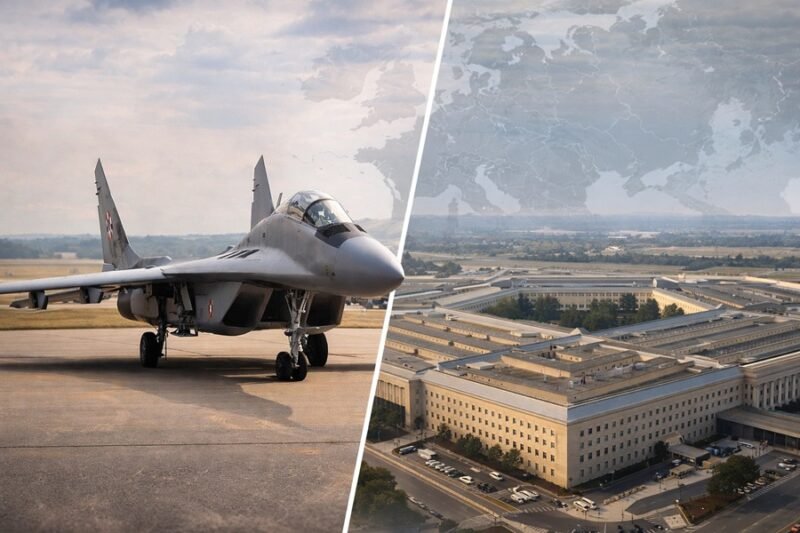
In the high-stakes arena of international military aid, few moments have been as confusing—and potentially explosive—as Poland’s sudden offer to transfer its fleet of MiG-29 fighter jets to Ukraine. The proposal, which involved handing the aircraft over to the United States first, caught Washington off guard and highlighted the delicate tightrope NATO walks between supporting Ukraine and avoiding a direct war with Russia.
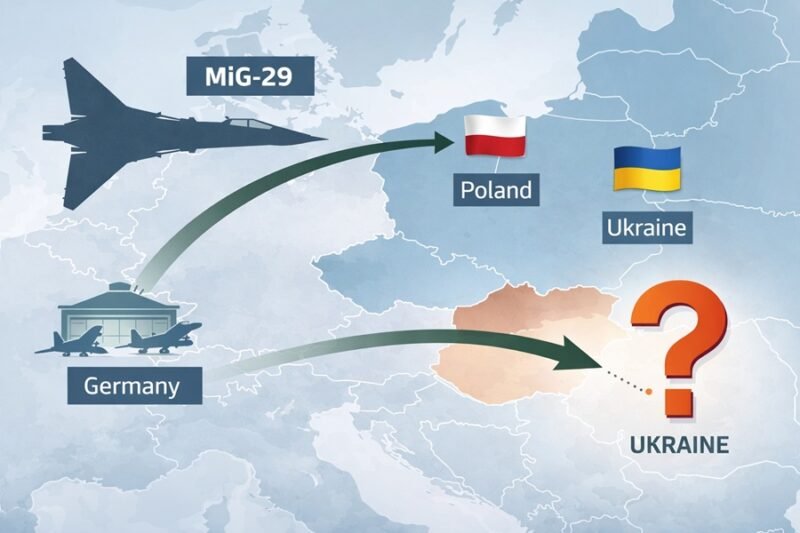
The announcement from Warsaw sounded simple on paper: Poland would deploy its jets to the Ramstein Air Base in Germany, placing them at the disposal of the U.S. government. From there, the assumption was that the U.S. would transfer them to Ukrainian pilots. However, the Pentagon quickly deemed the plan “not tenable,” exposing a rare public rift in strategy among the allies. Understanding why this deal fell apart requires looking at the tactical realities of the MiG-29 transfer and the terrifying geopolitical risks involved.
The Details of Warsaw’s Surprise Announcement
The Polish Ministry of Foreign Affairs released a statement that stunned officials in Washington. They announced readiness to deploy all their MiG-29 jets to Ramstein immediately and free of charge. In return, Poland asked the United States to provide them with used aircraft with corresponding operational capabilities, likely F-16s, to fill the gap in their own air defense.
This move was politically shrewd for Warsaw. By transferring the jets to U.S. custody first, Poland effectively tried to make the transfer a NATO or American operation, rather than a unilateral Polish one. As a nation sharing a substantial border with both Ukraine and key Russian ally Belarus, Poland is acutely aware of its vulnerability. They were willing to help, but they didn’t want to paint a target on their own back by sending warplanes directly from Polish airfields into combat.
Why the Pentagon Rejected the Proposal
The U.S. response was swift and negative. Pentagon Press Secretary John Kirby stated that the prospect of fighter jets departing from a U.S./NATO base in Germany to fly into airspace contested by Russia raised serious concerns for the entire NATO alliance.
The Risk of Direct Escalation
The core issue wasn’t the hardware; it was the logistics of delivery. If a Ukrainian pilot takes off from a Polish airbase or a U.S. base in Germany and flies into Ukraine to engage Russian forces, Moscow could interpret that base as a legitimate party to the conflict.
Russia has repeatedly warned that any country allowing its soil to be used for launching attacks would be considered a combatant. A direct transfer from a U.S. base risks triggering Article 5—the NATO clause that says an attack on one is an attack on all. Washington’s calculus was clear: the benefit of a few dozen older jets did not outweigh the risk of igniting World War III.
Tactical Limitations of the MiG-29
While symbolic, American military planners also questioned the actual utility of the transfer. The airspace over Ukraine is heavily defended by Russian surface-to-air missiles. The Pentagon argued that adding more fixed-wing aircraft wouldn’t significantly change the effectiveness of the Ukrainian Air Force compared to the ground-based anti-air systems (like Stingers and Javelins) that the West was already supplying in massive numbers.
Why the MiG-29 Matters to Ukraine
Despite the logistical hurdles, Ukrainian President Volodymyr Zelenskyy had been pleading for these specific aircraft. The reason is training.
Modern fighter jets are incredibly complex machines. A pilot trained on a Soviet-era MiG-29 cannot simply hop into an American F-16 or F-35 and fly it into combat. It takes months, if not years, of training to master the avionics, weapons systems, and handling characteristics of Western jets.
The Ukrainian Air Force already operates MiG-29s. Their pilots know the airframe inside and out. They have the spare parts, the mechanics, and the infrastructure to keep them flying. This made Poland’s fleet the only immediate solution for replenishing Ukraine’s dwindling air power without requiring a massive retraining program in the middle of a war.
The Problem of Backfilling
Poland’s condition for the transfer was that the U.S. would “backfill” their fleet with used F-16s. While reasonable, this is not a quick process. Manufacturing, upgrading, and delivering replacement fighters takes time—time that Poland would spend with a significant hole in its air defenses while a war raged right next door.
The Diplomatic Fallout and Future Aid
The public nature of the disagreement was unusual for the close alliance. Usually, these deals are hammered out behind closed doors before being announced. The disconnect suggested a breakdown in communication, with Poland seemingly trying to pressure the U.S. into accepting the risk.
However, the “failed” deal shifted the conversation. It moved the “Overton window” regarding what kind of heavy weaponry the West was willing to send. While the jets were stalled, the conversation pivoted toward tanks, long-range artillery, and eventually, training programs for Western jets. The MiG-29 saga served as a stress test for NATO’s red lines, forcing the alliance to define exactly how far it would go to support Kyiv without putting boots—or tires—on the ground.
Frequently Asked Questions
Why couldn’t Poland just fly the jets to Ukraine directly?
Poland feared that flying combat aircraft directly from Polish airfields into Ukraine would be viewed by Moscow as direct participation in the war. This could have invited Russian retaliation against Polish territory, potentially dragging NATO into a broader conflict.
Are Ukrainian pilots trained to fly American F-16s?
At the time of the proposal, no. Ukrainian pilots were trained primarily on Soviet-era aircraft like the MiG-29 and Su-27. Switching to Western platforms like the F-16 requires extensive retraining, not just for pilots, but for maintenance crews and logistics teams.
Did Ukraine ever get fighter jets from NATO allies?
Eventually, yes. Later in the conflict, Poland and Slovakia did transfer MiG-29s to Ukraine. The initial hesitation eventually gave way as the war progressed and NATO’s assessment of Russian “red lines” evolved.
The Bottom Line
The saga of the Polish MiG-29s illustrates the complex friction between moral obligation and strategic survival. Poland wanted to help a neighbor without sacrificing its own security; the U.S. wanted to support Ukraine without triggering a nuclear confrontation. While the specific transfer through Ramstein was rejected, it paved the way for the increasingly heavy weaponry that continues to flow across the border today.
Must Read: Semiconductor Diplomacy: Why Microchips Are the New Oil
