

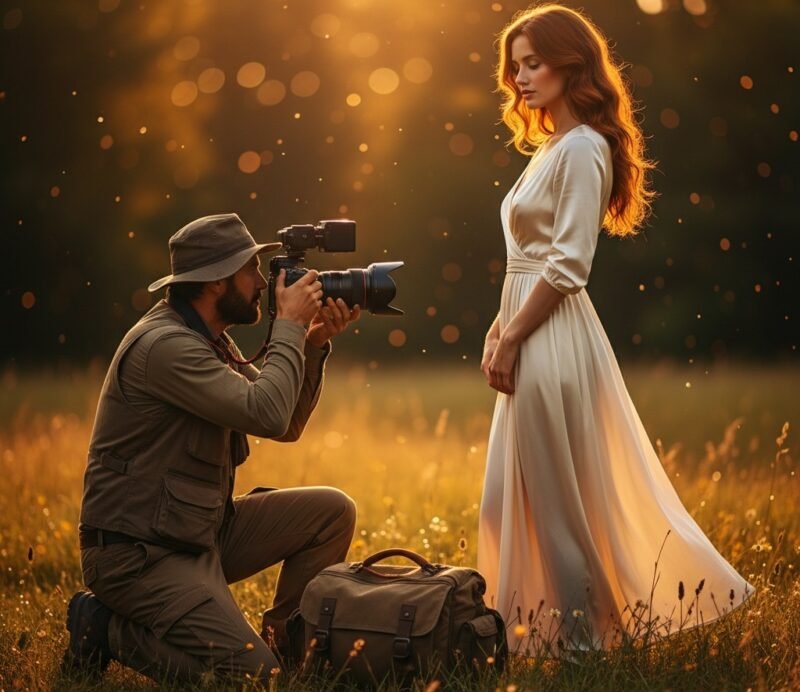
Every photographer eventually faces the same dilemma: Gear Acquisition Syndrome (GAS). You look at your camera bag and wonder what piece of glass will take your work to the next level. If you are focusing on people, there is one focal length that stands above the rest as the gold standard. It isn’t the versatile 50mm or the dramatic 35mm. It is the legendary 85mm.
Often referred to as the “portrait lens,” the 85mm prime lens is a staple in the kit of almost every professional wedding, fashion, and lifestyle photographer. While zoom lenses offer convenience, they rarely match the specific aesthetic quality that a dedicated portrait prime provides. There is a distinct “look” to images shot at this focal length that immediately signals high production value.
But what exactly makes this specific focal length so special? Why do professionals swear by it, and why should it be the next investment for your camera bag? From optical physics to psychological comfort, here is why the 85mm lens is the undisputed king of portrait photography.
1. Unmatched Bokeh and Subject Separation
When you look at professional portraits, you likely notice how the subject seems to pop off the screen while the background melts away into a creamy, non-distracting blur. This effect is known as bokeh, and the 85mm lens is a master at creating it.
Most 85mm lenses are “fast,” meaning they have wide maximum apertures like f/1.8, f/1.4, or even f/1.2. When you combine a telephoto focal length with a wide aperture, you achieve an incredibly shallow depth of field. This allows you to isolate your subject completely. A busy street, a messy park, or an unappealing room transforms into a soft, artistic wash of color. This separation forces the viewer’s eye directly to the subject’s face, making the image impactful and clean.
2. The Most Flattering Focal Length for Faces
Distortion is the enemy of a good portrait. Wide-angle lenses, such as 24mm or 35mm, tend to exaggerate features closest to the camera. If you take a headshot with a 35mm lens, the subject’s nose will appear larger, and their face may look unnaturally narrow or stretched.
On the other hand, super-telephoto lenses (like 200mm) can sometimes make a face look too flat. The 85mm sits in the optical “sweet spot.” It provides just enough compression to flatten the features slightly—which is generally very flattering—without making the face look two-dimensional. It renders human proportions accurately and naturally, making your subject look like the best version of themselves. If your goal is to make people love how they look in photos, this lens does half the work for you.
3. The “Goldilocks” Working Distance
Photography is as much about psychology as it is about optics. The physical distance between you and your model dictates the energy of the shoot.
If you shoot with a 35mm or 50mm lens, you have to be physically close to your subject to fill the frame with their face. This can be invasive and uncomfortable for people who aren’t professional models. It invades their personal space, often leading to stiff expressions. Conversely, using a 70-200mm zoom at the long end requires you to stand far away. You might find yourself shouting directions to be heard, which kills the intimacy of the session.
The 85mm offers the perfect middle ground. You are close enough to communicate easily and maintain a connection, but far enough away that the subject doesn’t feel crowded. This comfortable distance puts people at ease, leading to more natural, relaxed expressions.
4. Background Compression
One of the less understood but powerful benefits of telephoto lenses is compression. This optical phenomenon makes background elements appear larger and closer to the subject than they appear to the naked eye.
Why is this useful for portraits? It gives you control over your environment. If you are shooting in a location that isn’t particularly scenic, an 85mm lens allows you to “crop out” the unwanted clutter simply by narrowing the angle of view. By pulling the background forward, you can fill the frame with a specific patch of leaves, a wall texture, or city lights, effectively eliminating trash cans, passing cars, or other distractions that a wider lens would include. It makes composing a clean shot significantly easier.
5. Incredible Sharpness and Detail
Prime lenses (lenses with a fixed focal length) are generally sharper than zoom lenses because they have fewer moving glass elements inside. Because 85mm lenses are designed specifically for portraiture, manufacturers engineer them to be razor-sharp where it counts.
When you nail the focus on the eyes with a high-quality 85mm, the level of detail is stunning. You can capture individual eyelashes and the texture of the iris with crystal clarity. While modern zoom lenses are excellent, a prime lens at this focal length usually offers superior micro-contrast and resolving power. This sharpness creates a professional polish that is hard to replicate with kit lenses or cheaper zooms.
6. Versatility in Low Light
Natural light photographers often struggle when the sun goes down or when shooting indoors. If you are using a standard kit zoom lens with an aperture of f/4 or f/5.6, you are forced to raise your ISO, which introduces digital noise and grain to your images.
Because most 85mm lenses open up to f/1.8 or wider, they let in a massive amount of light. This allows you to keep your shutter speed fast enough to freeze motion and your ISO low enough to maintain high image quality, even in dim conditions. Whether you are shooting a reception in a dark wedding venue or a portrait session during the last fading moments of twilight, the 85mm is a reliable tool that lets you keep shooting long after other lenses have failed.
7. A Professional Look with Minimal Distortion
There is a subtle quality to 85mm images that screams “professional.” It is a combination of the lack of distortion, the compression, and the depth of field.
When you shoot full-body or three-quarter length portraits with wider lenses, you often have to tilt the camera to get the framing right. This can cause “keystoning,” where the vertical lines of buildings or rooms look like they are falling backward. The 85mm lens naturally corrects for much of this perspective distortion. Your vertical lines stay straighter, and the subject’s body proportions remain true to life. This results in images that feel balanced, grounded, and high-end.
Elevate Your Portrait Game Today
The 85mm lens has earned its reputation as the king of portraits for a reason. It solves many of the most common problems photographers face: creating background separation, handling low light, and making subjects look their absolute best.
While it takes some practice to get used to a fixed focal length—you have to zoom with your feet!—the payoff is worth the effort. The images you produce will have a timeless, cinematic quality that sets your work apart. If you are ready to stop taking snapshots and start creating art, adding an 85mm lens to your kit is the best decision you can make.
Must Read: How to Write Address on DTDC Courier: A Complete Guide
